
Feel Unappreciated in Your Marriage? Here’s How to Fix It
Do you feel used and unappreciated in your marriage? Feeling undervalued can lead to emotional disconnection. Let me help you stop feeling emotionally neglected and improve your marriage.


Understanding Resentment in Relationships
When we give more than we think is fair or don’t get what we feel we deserve for our efforts, we become resentful.
While many people try to hide their resentments, those feelings still have a negative impact on their marriage, even if you never show your resentment toward them. Your feelings of love for your spouse, your kids, or even your employer, will make you less and less satisfied. Unfair burden and loving feelings don’t naturally occur together.
Emotional Signals and Self-Assessment
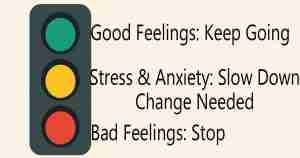
Your feelings are not good guides to action, but they can signal marriage problems. Our feelings are like traffic signals for our behavior. Good feelings are like a green light and mean keep it up. But bad feelings are like a red light and means stop right away. And mild stress and anxiety are like a yellow light and means you are about to go into the red zone.
Unlike the way people actually drive in the USA, such yellow light feelings should not encourage you to speed up, but to slow down and make changes before things get worse. Feeling used and feeling unappreciated are yellow lights that indicate a need to make changes. Preventing emotional burnout is much easier than recovering from it.
Have you stopped to ask yourself how you feel lately? Taken your emotional temperature? Are you enjoying your marriage, your other relationships, your job? Are you spending time doing things that you enjoy? Look for green, red, and yellow emotional signals.
Taking Action: Reducing Resentment

Your first step for dealing with resentment is to ask yourself if you are actually giving or doing too much.
If your answer is yes, then figure out specifically what you are doing too much of. Are these things far above and beyond what you would expect from your spouse if your roles were reversed? Many people actually choose to go the extra mile, doing far more than their spouse expects. If that is the case with you, then your anger needs to be directed to that person you see in the mirror who is making you do it.
Don’t blame your spouse for not rewarding you, for giving yourself a hard time. Although it sounds simple, if you are doing too much, then do less. For example, you might feel resentful because in addition to your job, you do all the cleaning at home. Fix that by letting people do their own laundry, or prepare their own lunches.
Make a chore list. Kids don’t get to play until their chores are done. You’ll meet resistance at first then people will adjust, and you will enjoy your family more. If you can afford it, hire cleaning staff, a laundry service, a garden service, or someone to come in and cook. The only prize you get for doing it all, when you can afford to get someone else to do it, is the booby prize.
You’ll not only be paying for the service.

You’ll be paying for less stress and more time to do things on your own or with your spouse. It’s a win all around.
Maybe the issue is not that you do too much, but that you get too little in return. If you’re not doing too much, but you are getting too little, then doing less will make things worse.
Doing less will give your spouse a legitimate reason to complain about you. Of course, then you can complain back, but this will just become a downward spiral of bitterness, resentment, and holding back love. That’s not a good way to build your relationship. Getting even never gets us more. Always do what you are responsible for, plus a little more, even if you feel unappreciated.
The better you make your marriage, the less you’ll be concerned about thanks for any particular job. Focus there rather than complaining or doing harm by doing too little.
Effective Communication with Your Spouse

A better action is to communicate clearly what you want. In a nice way. Don’t let your husband’s or wife’s excuse ever be you didn’t tell me.
If you believe that your husband or wife should know what you want, but you are not getting it, then it is time to assume their cluelessness. Even people who are brilliant in some areas can be very stupid in others.
Never try to say what you want through sarcasm. Sarcasm is never nice. Sarcasm is a passive aggressive way to complain or criticize nicely.
Fill him or her in on what you want. Honey, I want you to thank me and give me a hug when I do things for you, for example, or I want you to spend two hours with the kids in the evening so I can have some time for myself. Be positive and be specific.
If you have a problem asking for what you want, it’s probably a self-esteem problem on your part.
If he or she refuses, then at least it’s not because of your lack of communication. Your lack of communication is always on you. Your spouse’s response is always on him or her. Don’t forget to communicate clearly what you don’t want, but in a nice way. Here’s a big tip for you. Be nice to anyone you’d like to get love from or be treated well by.
Surprisingly, I’ve had quite a few people tell me that they never realized they needed to be nice to their spouse.
Now I’ve communicated that to you, so it’s on you whether you do it or not.
Love Languages and Mismatched Expectations
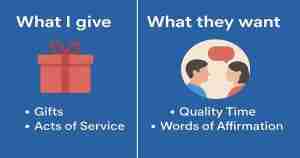
Did you know that often our partners are trying to show us their love by giving to us what they want, enjoy, and need?
For example, a spouse who wants physical affection may be giving you physical affection to show his or her love for you. The same is true for compliments, gifts, and the other love languages.
People tend to express their love in the same way they want to receive it.
That’s great if we both have the same needs and desires. It works with couples who are well matched on values, interest and desires. It creates a reciprocity that can keep the relationship going well.
It works that way with friends too. Mismatches are where problems can occur. For example, one person may like gifts, while another likes practical help better; or one person likes talking while another prefers activities. This can easily create a situation where your spouse thinks he or she is showing you a lot of love, but you feel like you are not getting much.
That’s because he or she is not expressing love in the way you prefer to receive it. If you like a lot of affection and your spouse is showing love by working extra hours to make money to buy gifts and activities, you are going to feel neglected rather than loved. It will be easy for you to become resentful and feel unappreciated.
There are a few ways you can deal with this situation.
Practical Solutions for Relationship Improvement

You might not want to shift completely into any of these solutions, but if you’ll do a little of each, it can make a big difference. One thing you can do is to nicely, there’s that word again, tell your spouse how to better make you feel loved, and how that increases your desire to do what makes your spouse feel loved.
This is a motivational approach and not just an informational one. A good principle to learn for relationship improvement is that information alone is not very motivating.
I prefer that you help with the chores rather than hugging me.
That is an informational statement, but is not a motivating one.
Actually, it’s likely to be experienced as rejection by your spouse, who is expressing love by giving hugs. Instead say,
When you help more around the house, it really makes me feel more like hugging you.
You are giving information, but also motivation. In addition, there is no rejecting statement included. You’re not saying you prefer help to hugs.

If you overuse this method, your spouse will feel manipulated, but in small doses it can create an upward spiral where you both get more of what you want–further building your feelings toward each other.
I want to point out this is not a relationship discussion. You’re just injecting a little piece of information nicely. You’re not telling each other your needs and what you would like the other person to do. That is a therapy technique, which often leads to short term change, followed by increased resentment when people stop doing what they feel is extra work. Don’t take my word for it.
Try them both and see what works better for you–relationship discussion. a therapy approach, or motivational statement, a coaching approach. Another thing you can do to change the overwork-resentment pattern is to make sure you are not giving too much of what your partner doesn’t want. This is another love language concept.
There’s only so much appreciation, love, and affection you can get from any person.

Even if your relationship is very healthy, your spouse’s personality is going to put limits on how much appreciation, love, and affection you get. Trying to get more than that causes self harm. Let me give you an analogy.
Every orange contains only a certain amount of juice and no more. Some oranges have more juice than others. If you squeeze a juicy orange, you’ll get some juice, but then no more, even if you really work at it. In fact, continuing to try to get more juice than it has to give will create disappointment, frustration, and hand cramps.
Hopefully you married someone whose personality allows you to get enough from the relationship to be satisfied.
A good guide to the maximum you can get is to look at how much your spouse has ever been able to give. A spouse who has never been very affectionate, even in your premarital days, is unlikely to become more affectionate than that.
The key to ending resentment here is to stop squeezing when there is no more juice. Understand that is all your spouse has to give and that your spouse is actually giving you all he or she can. Your husband might not be as romantic as another woman’s, but your husband’s romantic gestures may be just as heartfelt.

A dandelion from a child can be as precious as a prized orchid from an adult. Judge people, not only by how much they do, but also by how much they’re able to do. You also need to make sure that if you want appreciation or reciprocation for what you are doing, that what you are doing is actually something your spouse likes.
Don’t assume that just because you would like your spouse to do that for you means that your spouse likes you doing it for him or her.
Of course, I’m still talking about mismatching love languages. Your spouse might not care that you do all the housework, but she might care about you having a cup of coffee and listening to her talking about something she enjoys talking about.
Your husband might not be moved by all of your admiration and compliments, but may be moved by you simply holding his hand or kissing him more often.
A little effort in the right place will get you much more appreciation than a lot of effort in the wrong place.
If you are putting a lot of effort into something that your spouse does not really care about, don’t expect much appreciation for it. In that case, the person making you feel used and unappreciated is you.
By the way, the exact same considerations are true for other family members and friends. Some people would prefer a compliment than two dozen chocolate chip cookies made with real butter. Other people would much rather have the cookies than the compliment.

You can still bake cookies for the person who would prefer compliments, but do it because you want to, not because you’re trying to get something from them. My wife and I do things for each other for two reasons. One is that we know the other person likes it. The other is because we want to. These help us to maintain our feelings of love as well as helping each other feel loved.
Make sure you have things you do because your spouse likes it, as well as things you do because you like to do them for your spouse.
Case Study: Ariel’s Marriage Transformation***

Consider Ariel, one of my clients who felt neglected by her husband. He seemed to like only two things, working and sex. He didn’t seem interested in spending any other time with her.
She worked hard to take care of their home and also was a good sexual partner for her husband. But as her resentment built, her love and motivation for her relationship was failing. Ariel was trying to earn her husband’s attention and he thought he was giving it to her by their sexual encounters.
They had a love language mismatch and misunderstood each other.
If they had gone to marriage counseling, this misunderstanding could have been cleared up. As a coach, I made a plan with Ariel that we would make some small changes and leave marriage counseling as a plan B.
In addition to teaching Ariel some marriage enhancement skills, she made three changes which greatly improved her relationship.
One was that she joined a volleyball club so that she could get some healthy time and attention with others. Secondly. She told her husband that when he went for walks with her, it made her feel more sexual. And thirdly, she stopped putting a lot of effort into preparing high quality meals because her husband would be just as satisfied with pre-cooked frozen meals from the grocery store.
These changes helped her and her husband to fix the emotional disconnect in their marriage. She might have gotten more time and attention if she had married a different man, but the other man might not have been such a good provider. Ariel’s change in perspective and behavior improved the marriage for both of them. The improvement was rapid and marriage counseling wasn’t necessary.
In fact, Ariel didn’t need to try to get her husband to work on the marriage at all.
Final Thoughts and Next Steps
There are many things we do in friendship, parenting, and marriage that we will not feel like doing. Our reward for that is a good relationship, even if we are not getting any recognition for what we do.
One final thing I want to point out is that if your relationship is bad, you are not likely to get much, if any, appreciation. Expecting to be appreciated in a bad relationship is unrealistic, causes resentment and anger, creates further emotional distancing, and causes the same feelings for both spouses.
Your spouse may not want anything from you because of the lack of connection in your relationship. You can’t kickstart your marriage by doing what your spouse previously wanted, but no longer does.
Instead, you have to go through the relationship building steps starting from where your spouse is emotionally. This is something I am helping my clients to do each day of the week. We assess where their spouse is and then make the behavioral changes, which will help their spouse to enjoy their company and look forward to seeing them again.
Each step we take helps them to be more attractive, connected, and appreciated by their spouse. See my Re-Connections coaching Package if you would like to work on rapid relationship improvement with me.
If you feel resentful and neglected, it isn’t waiting for your spouse to change which will help. It is you deciding to take steps because you love your spouse, and because you can.
For further study: How anger and resentment can affect your physical health.