

Should You Keep Trying If Everyone Says Your Marriage Is Over?

Making the wrong decision about working on your marriage or leaving it can lead to a lot of regret and wasted time later. What factors can help you decide?

There are two risks when it comes to working on a bad marriage.
One risk is the time and opportunities you lose if you don’t let go of your marriage and move on. If you spend a year doing that, it’s not too bad. But what if you spend two years, five years, or more? When the relationship eventually ends, you will wish you had divorced much sooner. And, you will never get those years back.
The other risk is giving up on a relationship that can be saved. If you find something much better, then it won’t make much difference. But what if you don’t find anyone better and you are left missing the person that you wish you had just tried a little more with?
Today, I will help you to know when to give up and and when not to. I will also tell you what you can do to make your chance to reconcile with your husband or wife more hopeful.
Your feelings can fool you
Most of the people I work with already know they want to reconcile. More days than not they are having bouts of hopelessness which keep them from sleeping at night and eating during the day. They constantly look for any glimmer of hope in the face of the one they love and don’t want to lose.
Often they don’t see any glimmers of hope at all. There hope is a fragile thread in danger of breaking. When they come to me and tell me their story, I can sense them holding their breath, waiting for my opinion about whether their marriage can be saved. As long as there is still contact, there is still hope, if you do things the right way.
What other people say is generally a lousy way to know whether to continue or not

Going online to find out whether you should work on your marriage or not will yield different answers. Some will say you should while others will say you shouldn’t. The way you phrase your question in the search engine will determine what kind of responses you get. Negative phrasing and positive phrasing leads to different results.
The same is true for how you phrase things when you talk with your friends.
If you say something like:
My lousy husband is cheating on me again. Do you think I should keep holding onto such a liar?
Guess what kind of advice you will get? Everyone is going to tell you to divorce.
How about if you asked,
I love my husband, but he is being unfaithful. What should I do?
That question will get you an entirely different set of answers from most people, though some people have their own biases no matter what you say.
One man I worked with would often ask himself,
How can she treat me so badly after all I have done for her?
That kind of negatively phrased question to himself helped him feel right and removed his sense of personal responsibility. It kept him from looking at what she should do rather than at what he could do. It kept him stuck.
I helped him to change that internal question to,
How can I help her to get back to getting the best from me, so we can both benefit?
That new question, focused on a win-win, led him to taking action instead of blaming. It also helped him make changes that improved his marriage.

People think they are looking for truth when they’re really looking for validation. That way they don’t have to feel guilty. They can feel justified and not responsible. Most people will validate them for the sake of their relationship. Validation is a social skill. So even if your friends or family don’t agree with you, they’ll often support your decision anyway.
Who can know what someone else really thinks and what they would actually do in your shoes?
Advice from counselors and coaches

Most counselors and coaches will prioritize validating you over helping you take responsibility to change. Why is that? So that you will enjoy their sessions and come back. That’s not the way that I work. I’ve had a few people get coaching from me sure that I would validate their belief that their relationship was hopeless. When I told them there was a path to reconciling, they got pretty angry. It’s not what they wanted to hear. They then dropped out of coaching.
Getting validation from a reconciliation specialist about your marriage being hopeless is looking in the wrong place. It’s like expecting a pastor to say it’s too late for you to be saved. If you want validation about your marriage being hopeless, a divorce lawyer would be happy to tell you that.
How should you respond to family and friends who encourage you to give up on your relationship?

I will tell you what I tell my clients–don’t argue or push back. Instead, use good social skills to show appreciation for their attempt to help. Then quietly make your own decisions, regardless of what they recommended.
Some people feel pressured by their parents to either reconcile or divorce. While their parents have good motivations, they don’t always have good advice. People in this situation need help managing their relationship with their parents at the same time they are managing their marriage. It’s easy to feel pulled in two different directions and to make a hasty decision that will lead to regret.
Getting hasty about trying to reconcile is not as big of a problem as being hasty to divorce. It’s much easier to change your decision if reconciling doesn’t go well. It’s much harder to change your decision if you have filed for divorce, though it can still be done.
A real life scenario:

My client Brooklyn was feeling pressured by her parents to give up the husband she loved because he was treating her badly. If he was physically abusive, I would have agreed with her parents. But many times a spouse’s bad behavior is a result of relationship problems and can be turned around.
Brooklyn and I worked together to find a way for her to validate her parents and use some of their advice while still working on the relationship. It was a delicate balance, but as her relationship with her husband started to improve, her parents softened. Brooklyn even helped them feel like they were part of the solution. I was proud of her and proud to help her, too.
We can learn from people who struggled until they succeeded about when to have hope
Let’s see if we can learn something from Thomas Edison, the inventor of the light bulb. Creating a working light bulb had never been done and he had not succeeded in thousands of attempts to create one. Can you imagine the advice he would have received if he asked his friends about what he should do?
I’ve tried 3,000 times to get this light bulb to work. I’ve failed every time. Do you think I should keep trying?
I’m sure Edison’s friends would have suggested that he needed some rest and relaxation and deserved a better life than getting frustrated all the time trying to make something work that obviously wasn’t. It’s not so different from a man or woman complaining that though they have tried many times, they just get rejection from their spouse. The advice would be similar.
What if Edison said instead,
I’ve found some ways to make light bulbs glow a lot longer than others. Although it has taken a few thousand attempts, I think I’m on to something.
Although it’s actually the same situation, everyone would encourage him to continue his research. (They might still think he should give up, though). Sometimes we can see the potential when others only see the problems. If you are never saying good things about your spouse to others, they will advise you to end your relationship.
This is why one of my personal rules is to never say anything bad about my wife to anyone.
There’s an important thing to note about Edison
He didn’t succeed because he kept doing the same thing over and over. He succeeded because he threw out what didn’t work until he found what did.
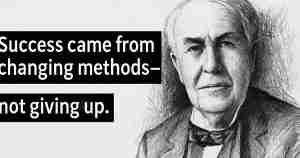
Some people get stuck in pursuit mode–trying over and over again to convince their spouse to improve or work on the relationship. Of course what doesn’t work one in ten times isn’t going to work in a hundred. Edison didn’t keep trying the same filament over and over. He tried different filaments until he found one that not only worked, but worked better than those he had partial success with.
Have you given up hope on your marriage because of what people have said, or because you keep trying the same approach without any lasting results? Maybe because of both of these reasons? They are the most common reason people divorce, even when the love in their relationship could be restored.
I encourage you to look for positive ways to rebuild your relationship, even if you have become very comfortable just blaming your spouse for everything. Even if everything is your spouse’s fault, there are productive things you can do to make your relationship better. I have some free downloads on my website for helping your husband or wife to enjoy talking with you more. That will help you as you work to build your relationship. The link is in the description.
What would I tell a friend who couldn’t decide whether to work on reconciling or divorce? I would ask which decision would be the most loving thing to do for their spouse. A decision made out of love is less likely to lead to regret and far more likely to be the right one. As God has told us in 1 Corinthians, Chapter 13, verse 13: And now these three remain: faith, hope, and love. But the greatest of these is love (NIV).


