Why Do We Keep Arguing about the Same Things? Here’s How to Stop
People don’t keep arguing about the same things because arguing works. It doesn’t. So why do they persist? And what can they do instead to break the argument cycle and improve their marriage? After this podcast you will know, and you can take your first steps toward a better marriage.

Most of the people who become psychologists, like me, have been asking why people do what they do since they were a child. Often it’s because something happens to them as a child which makes them question what is happening to them. Abuse, neglect, mistreatment by peers, and physical and psychological disabilities can all make us question “why?”

Going from why it happens to how you change
Part of overcoming trauma is getting past the past oriented “why” to the future oriented “how.” “How can I do better?” “How can I motivate others to like me?” and so on. Some of my clients are stuck in “why” mode, preventing them from taking action. Often we need to take action to make changes even when we don’t clearly know why something happened.
A mind freeing self question is, “Regardless of how I/we got here? How can I/we do better going forward?” This takes the emphasis off of blame which it not helpful, and puts it on solutions, which are.
Arguing about who washes the dishes is not going to be solved by figuring out how they got dirty. A fair chore schedule going forward would be helpful.
If you have a flat tire, it’s not necessary to know why in order to repair it.
That being said, if you get flat tires regularly, knowing why is very important. You might have something in your garage which is puncturing your tire. Consistently arguing about the same thing is like that. If you frequently argue about different things, then I wouldn’t focus on why. Instead, I would focus on learning a more effective skill for dealing with problems. Then the arguing would stop.
People with effective skills never have to argue. Never.
Let’s take a look at some of the reasons why people argue about the same things and what they can do to fix that underlying cause.
Not knowing any other way to solve relationship problems

One reason people continue to argue is that the problem they want to fix is ongoing and they don’t know how to fix it other than to argue. I think this is the number one reason. Arguing can only happen if both people do it, so it means that their spouse also doesn’t know a better way of fixing the problem.
One person wants one thing, and the other person wants another thing. One person wants to have opposite gender friends and their spouse doesn’t want that. One person wants to save for retirement and the other wants to spend their money now. One person wants to stay home and the other wants to go out.
Arguing won’t fix any of these opposite desire issues. With enough force you can get resentful compliance, but that damages the marriage. Even without force the message in arguing is invalidating. The core message in arguments is “you are wrong.” This is invalidation.
Validation builds relationships, invalidation weakens them–whether you are right or not.
Combine invalidation with a failure to prioritize the relationship, and you will have divorce. These behaviors are connected since the more you argue (invalidate), the less each of you will desire to spend quality time together and the less love you will feel for each other.
Believing arguing helps solve marriage problems

Another reason people argue is that they believe it is an effective way to solve problems. This may be because they got resentful compliance when they argued before and didn’t notice that it also damaged their relationship. Or it may be because they have learned it’s what they are supposed to do. It’s part of their marriage script. Many people learn marriage scripts from their parents. Another contributor is misinformation from non-Christian sources.
Arguing is a love killer. Never believe you should argue or that it is healthy. The Bible tells us to avoid it. It isn’t possible to fight your way to a better marriage.
People who believe that it is, only stop arguing when they give up. That can lead to acceptance. It can also lead to rejection.
Arguing to feel in control in marriage

Power is more rewarding than love or money. It is why many rich people continue to do bad things even though they could just enjoy their prosperity. But, even among the very poor, the desire for power is strong. No one wants to feel powerless. Arguing, shouting at people, giving unwanted advice, criticizing, and blaming are all needy behaviors.
People do them to try to feel better or create positive change. Needy behaviors like these just make us feel worse with worse relationships. We need to nurture love and respect in our spouses rather than try to squeeze it out of them.
People who do these needy behaviors are also are very insecure. They fear what would happen if they didn’t argue, complain, criticize, and so forth. Their thinking is something like this, “If I don’t argue, then he/she will do bad things, which will be dangerous.”
Some are afraid their spouse won’t love them, that they will cheat, create debt, alienate the family, damage the kids. The irony for such insecure people is that needy behaviors push the other person away, making their fears come true instead of preventing them.

I wrote my book, Overcome Neediness and Get the Love You Want, for just such people. It is my most popular book.
Arguing to get revenge in a relationship
It is human nature to want to hurt those who have hurt us. Jesus’ teaching to love those who hurt us can’t be done without the help of the Holy Spirit who indwells every true believer. It make Christians appear crazy to people bent on revenge.
The fact is, most people who feel disrespected, mistreated, or neglected are quick to criticize and argue–even when they know it will make things worse. Many people who would never use drugs are addicted to revenge. The consequences can be devastating.
The truth is everyone will do something which hurts us. If our response to that is to hurt back, then there is no hope for a long and loving marriage. No one will ever be able to find a spouse who never hurts them in any way.
Revenge is never encouraged in the Bible. The eye for an eye passage is a direction for judges to create fair punishments. Jesus gives direction for the everyday person:
“But I tell you, love your enemies and pray for those who persecute you (Matthew 5:44, NIV).”
Arguing to create emotional distance in marriage

Arguing does have a useful function when we want to create emotional distance. Distance is needed either when the other person is a danger, or when the other person won’t give us enough space. Men and women would both do well to be more invalidating to those who would try to get them to cheat on their spouse.
And, if people are divorcing, I have no problem with them arguing and being critical, because it will help them and their spouse to emotionally detach. Not everyone should stay married. Toxic marriages should either be fixed or left. It makes no sense to drink poison day after day. God wants us to reconcile, but he does not want us to live in contempt of each other.
Love your spouse or leave your spouse because there is no good middle ground.
Too much of a good thing is a bad thing
The amount of time we spend together has to do with our feelings towards each other and our personality. Two different people who are equally loving may desire to be with each other more or less. I am fortunate in that my wife and I feel the same way about each other and want no more than two hours a day with each other. This drives us to spend the right amount of time together, which helps to keep our relationship positive and stable.
For some spouses, because of different feelings and/or personalities, one person wants much less time together than the other. If that person has more time together than they want, they will tune out, become critical, or argue in order to create emotional and/or physical space.
When I am helping people to reconcile, I must often help them to spend much less time with their spouse while also helping them to make their interaction more positive. This gets the relationship moving forward again.
Let me illustrate with a client example:
Jareb told me that he was trying to get close to his wife, but whenever he thought things were going well, they would argue. His wife would bring up things he had done in the past that she hadn’t liked, become distant for a day or two and then become friendly again. Jared told that there didn’t seem to be any way to resolve those long standing issues.
I asked him how much time he spent with his wife when she was in a good mood. He said it would be most of the day. I recommend he gradually cut that time down. He resisted because he didn’t want to have even less time with his wife, but agreed to try it as an experiment. He quickly found that reducing time together resulted in fewer arguments. Over the next few months he was able to stop the arguments, which his wife had been using to create distance.
Beware that going “no contact” is not helpful as it does not allow for positive interaction.
How to stop arguing and fix your marriage
Change your beliefs about arguing

The best way to change your beliefs is by learning from experience. Watch what happens when you argue. It is helping? Or is it hurting? Does it help in one way, but hurt in another? Ask yourself if continuing to argue will get you want you want. What will happen if you continue to argue? Are you addicted to it? How long can you go without arguing or being critical?
Honestly answering these questions will help you to resist misinformation and to be more consistent with God’s Word, which never fails.
Use better ways to handle marriage problems without arguing
Arguing is for creating more problems and for distancing. It is not even a way to address problems. Silence is better than arguing.
But, better than silence is:
- learning to validate,
- problem solve,
- make positive requests,
- positively motivate, and
- use good boundaries to effectively deal with disrespect
These skills will enable you to change the conditions of your marriage so that it can grow and thrive.
Improve the way you communicate with your husband or wife
Your spouse can’t argue with you unless you argue with your spouse.
Like playing catch, the game stops if one person quits. What will you do instead?
You will:
- listen,
- validate,
- problem solve, and
- use boundaries.
This will entirely stop your spouse’s attempts to argue, while also preserving your relationship.
Overcome misguided fear and criticism in marriage
Fear of abandonment or rejection actually leads many people to argue in an attempt to “protect” their relationship. Fears are self-fulfilling. Overcome your fears of abandonment, financial ruin, child harm (unless they are being abused), intimacy, family reactions, being different from others, and so on.
Learn to live and love freely within the context of a Christian marriage, while trusting God to help you if any problems do arise.
Build confidence and happiness outside your marriage
Miserable people argue much more than happy people. If you depend on your husband or wife to make you happy, you will be much more critical and argumentative.
- Worship God with others,
- read the Bible,
- pray,
- have a passion other than your family and job,
- stay fit or get fit,
- turn off the negative media, and
- spend time with friends every week.
When you do these things you will be less fearful for your relationship and more positive with your spouse. Both of those things will help to strengthen and preserve your marriage.
Learn how to love a difficult spouse, while still having good boundaries

If you can work to be desirable to your spouse, while treating your spouse like the man or woman you love and desire, you are half way to a great relationship.
If you also have a life of your own, you are three quarters there.
If you also have good boundaries to end bad behavior and not become resentful, you will make it all the way to the relationship that you once dreamed of having.
The good news? All of these behaviors are under your control. Your spouse is not preventing you from being happy or having an enjoyable relationship.
God gives us free will. Freedom is not permission to do bad things. It is the opportunity to do good things that will enhance your life and marriage. You have that freedom.
Spending less time together can end arguing and improve your marriage
If your spouse wants less togetherness than you, then you can use a one-two combination to improve your marriage. First, make sure you are interacting in a relaxed, friendly, and validating way. Secondly, gradually decrease your time together until your spouse is looking forward to seeing and talking with you.
You will know when you get the amount of time right because there will no longer be an up-down, roller coaster, pattern of relating. Such roller coaster patterns are caused by either not being on the same page or spending more time together than one person wants. These are common in emotionally distant relationships, but can be easily fixed.
Not arguing does not mean being submissive to bad behavior

I encourage you to submit to a loving, godly spouse, whether you are a man or a woman. I also encourage you to submit to authority whenever it doesn’t contradict the Word of God, which is the Bible.
Submission is not control when we do it of our free will. It is self-control.
If your spouse, government, friends, employer or family want you to violate your values and God’s teaching, don’t do it. Part of my measure as a Christian is my ability to say “no” to those who oppose God, no matter what it costs me. Part of my measure as a husband is my ability to say “no” to my wife to ungodly behavior which would damage her or our marriage.
Boundaries replace arguing when dealing with a difficult spouse
Of course I am talking about boundaries. Boundaries are not for revenge, but for protection and preservation. Boundaries include refusing to argue or participate in damaging behavior. Simply saying “no,” and refusing to do whatever it is–without trying to convince your spouse that he or she is wrong–is often the easiest solution.
You actually will be respected more by being able to say “no” to bad things. However, it is important that you be loving the rest of the time. Even when you say “no,” don’t be hostile about it. Just be firm.
You can say something like, “I know you think that is the right thing to do, and even if I am wrong, I am not going to do it.” Give the same answer up to three times and then just walk away if your spouse persists. I have a quiz called “How Effective Are Your Boundaries,” which you can find on my website in the Learning Center. I will put the link in the description.
Learn marriage skills that end arguments

Knowing how to build your relationship, how to motivate your spouse in good ways, how to plan for problems rather than fear them, how to make positive requests, and how to have good boundaries are all relationship skills that many people don’t have.
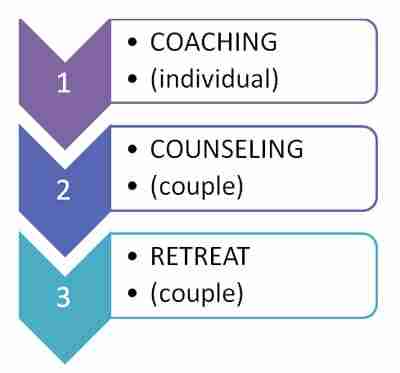
If you get relationship coaching, you will be able to learn and practice these skills with your coach before using them with your spouse. The result will be more confidence, better skills, and faster relationship improvement.
You can stop the arguments and restore peace starting this week. We can work one-on-one to do that together when you sign up for either my Difficult Partner Coaching Package or my Secure Partner Coaching Package.
Don’t continue to argue when there are better choices available. You can get the love and affection you want without conflict and without being a doormat.

For Further Study:
Lavner, J. A., Karney, B. R., & Bradbury, T. N. (2016). Does Couples’ Communication Predict Marital Satisfaction, or Does Marital Satisfaction Predict Communication?. Journal of marriage and the family, 78(3), 680–694. https://doi.org/10.1111/jomf.12301