How to Get Your Spouse to Work on Your Marriage (Without Conflict)
You can motivate your spouse to do many things, including treating you better and working on your marriage. But, a direct, single step approach is likely to just get you resistance and make you feel stuck and hopeless. Let me help you with a more effective approach to get your marriage back to the way you really want it to be.
I have been helping people to rebuild their marriage with rejecting spouses for more than thirty years. The most common ways that I see people trying to motivate their spouse to work on their marriages are:
- reasoning
- appealing to the welfare of the children
- arguing and blame,
- shaming,
- begging and pleading
- unwanted pursuit
I will talk about these just briefly so you can get a better idea of why they don’t work, why they will make you stuck, and why you should stop doing them (if you are).

Why logical arguments don’t work with a checked-out spouse

Reasoning is a logical choice and that is both the strength and the weakness of it. The fact is that when a husband or wife loses interest in their marriage and are checked out, it is an emotional issue rather than a logical one.
No amount of reasoning will turn on a spouse’s desire to work on, or remain in a relationship. Some people will make an effort based on reason, but the lack of emotional connection will result in minimal effort.
Logical people must learn, even if they don’t understand, that people may come together for logical reasons, but they will only stay together if they are emotionally satisfied. I have worked with many computer techs and engineers who had to learn this the hard way.
Why appealing to the welfare of the children backfires

Appealing to the welfare of the children, like reasoning, can get some people to endure their relationship longer. One of the main problems with this approach is that is prioritizes the children over the spouse and often adds to marital damage. There are some people who will endure a marriage until the kids are grown, but who then divorce.
If you are a woman, consider that getting a man to stay with you just until the kids are grown will make it more difficult for you when the divorce eventually happens. This is because it is more difficult for women to begin new relationships as they get older. It may not be politically correct, but political correctness has little to do with reality.
Forget political correctness and live in the real world for maximum effectiveness and good relationships. Jesus never cared about political correctness–only what the Father wanted.
Why arguing, blame, and shaming create more distance

Arguing and blame are many people’s go-to for getting their spouse to do anything. It is also one of the major reasons that spouses don’t want to work together in the first place. The more you argue or blame to get your spouse to work with you, the more your spouse will want to get away from you.
You can’t fight your way to a better relationship and you will never be able to blame someone into liking you.
Even if your spouse is the major cause of the problems in your relationship, pointing that out will not motivate your spouse to work on your relationship or make changes in himself or herself.
Shaming is appealing to a person’s sense of right and wrong–their morality–while also pointing out that they are in the wrong. While this is logical and can get temporary reluctant compliance, it is a love killing behavior. This is because people relieve their sense of guilt not by changing for the better, but by coming up with justifications for their behavior.
For example, people who once felt guilty about not going to church now say that the church is full of hypocrites, they can worship God in their own way, and that God understands their reasons. The result–guilt is gone and they are even more negative toward the church. The same thing can happen to you.
If you shame your spouse, your spouse will soon come up with reasons to justify his or her behavior. Your relationship will become worse off in the process.
Why begging and pursuing an emotionally disconnected spouse fails

Begging and pleading is an attempt to get your spouse to take care of you with some kind of caretaking and sacrificial action. This is a big turn off to both men and women. The more this tactic is employed, the more numb to it your spouse will become. It also triggers justifying behavior in your spouse, just as shaming would. The result is you will feel like your spouse cares less and less about you, which will be true.
Unwanted pursuit is also repulsive, especially with an emotionally disconnected husband or wife. In order for pursuit behavior (such as romantic compliments, initiating physical affection, and initiating dates) to be helpful, your spouse must already want it. You have to create some connection before your spouse is going to want more. People aren’t going to want more of your cooking if that first bite doesn’t taste good.
The confusing thing about this for many people is that once upon a time their spouse did enjoy the pursuit. It’s not hard to understand really. Our desire to interact with someone changes with our feelings toward them. Most likely there are some people you used to enjoy doing things with, but no longer have the desire to even see.
The result of unwanted pursuit for your spouse will be you getting unwanted rejection. And, the more your spouse refuses your advances, the harder it will be to make progress with your relationship.
The neediness underlying these methods

The moral to these methods is don’t use coercive and unenjoyable behavior to try to motivate your spouse to work on your marriage. You can’t attract flies with vinegar and you can’t attract your spouse to you with needy behaviors like these. One reason that many people have a bad marriage is the presence of these needy behaviors in the first place. If I had to choose just one needy behavior that damages more marriages than any other, it would be criticism.
If you think being open and honest about what you don’t like is helpful, just think about how you feel when your spouse is open and honest with what he or she doesn’t like about you. Do unto others as you would have them do unto you (Matthew 7:12). Jesus’ gold rule is great for marriage.
Hear me on this–I am not saying you need to work on your marriage alone. But, I’m not saying you need to work on your marriage together either. The reality is that there is much you will need to do on your own before your spouse will work with you together. Don’t think of it as an either-or.
The relationship continuum,–your key to motivating your spouse to work on the marriage
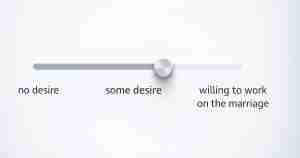
Let me help you to understand this better. There is relationship continuum from totally loving you to totally hating you with many points in between. Everyone you know is somewhere on this continuum, including your spouse. Not only that, but their position on that continuum shifts around a little on a day to day basis, and possibly a lot as time goes by.
On the totally loving side of the continuum, your spouse would climb the highest mountain for you if it pleased you. On the totally hating side, your spouse would wish he or she never met you and couldn’t think about you without grimacing. Somewhere between those two points, is the point where your spouse wants to work on the relationship with you.
That point is going to be somewhere further along in the positive direction from where you are now. If your spouse wants a divorce, it just means he or she is further down the negative side of that continuum and you will need to do more steps to move him or her back in the positive direction.
Why your spouse isn’t ready to work on the marriage yet
Your job, if you want your spouse to work with you, is to get your relationship to that point in the continuum where your spouse wants to. Your job is not to try to get your spouse to work with you while he or she is on the negative end of the continuum. That would just cause rejection.
A helpful analogy for why your spouse rejects your efforts

Let me use an analogy. When people first meet, they are generally not at the place where they want to get married. They don’t hate you, but they are not in love with you either. This means if you walk up to a stranger, introduce yourself and propose marriage, you are likely to be rejected.
Arguing, begging, pleading, shaming, and so forth is not going to change that person’s mind. In fact it will move them the wrong way on that love-hate continuum. They will want to get away from you. You will be seen as a nut case. The problem isn’t your wanting to get married. The problem is that the other person is not yet at the point where they want to marry you.
Does this mean that you can never get married? Of course not. But it does mean that you have to, on your own, grow the relationship to the point where the other person actually wants to marry you. That’s right–you have to do that much on your own. It will not work to meet someone and try to get them to agree on working together with you, perhaps in counseling, to get to the point where they want to marry you.
Why problem-solving and discussion fail to motivate

Interestingly, getting your spouse to the point where he or she wants to work on your marriage involves the same steps as getting a stranger to want to marry you. Many people get tripped up thinking rebuilding a marriage is different from just building a relationship. It isn’t.
Many people assume that, since they are already married, resolving marriage problems is a matter of discussion and problem solving. What they don’t realize is that we only discuss or work together as a couple when our spouse has the same motivation as us. Otherwise we don’t create solutions; we create conflict and distance.
When talking can make marriage problems worse
The first step in joint problem solving is getting on the same page. So, the question you need to ask yourself is, “Does my husband/wife want the same outcome as me?” Until you can answer that with a “yes,” it is not time to approach your spouse with the problem. It would only lead to conflict. I lay out all the steps to joint problem solving in my book, Connecting through “Yes!”

Do not be problem avoidant, but do be conflict avoidant. Conflict avoidance gets a bad wrap in this backwards society, but it is what the Bible promotes. Take your problems to God and use a loving approach with your spouse. Find peaceful solutions and don’t fight.
How can you solve problems if your spouse isn’t on the same page?
How to create desire instead of resistance

Suppose you and your spouse stopped dating a long time ago and you would like to start dating your spouse again. Now, you could just bring it up with your spouse, but if your spouse doesn’t want to date, you will get rejection of one kind or another. He or she may be outright rejecting, make a polite excuse, or agree to date and then back out later.
For this dating example, you need to ask yourself, before approaching your spouse, “Do I think my husband/wife would like to date again?” If you are sure that he or she does, then invite your spouse out. There is no need for a big discussion. But, if you think your spouse would not, then don’t bother to even discuss it.
Most people think, “Well, if I can’t discuss it, then how are we going to change it? We will never date again and live as roommates.” Their strong belief in discussing problems would lead them to discuss and create distance. Then, they would be worse off than before.
What you can change to increase your spouse’s desire

Instead of discussion, if you decide your spouse is not on the same page as you, you need to ask yourself another question. That question is, “What can I do to help my spouse want what I want?” In the case of dating, “What can I do (other than discussing), that will help my spouse want to date me?”
This, of course, is the same question single people need to ask themselves if they are interested in dating or marriage. For dating, there are a number of things a person could do that would be helpful, such as:
- ending all needy behavior which turns off their spouse
- helping their spouse to enjoy talking with them more at home
- dressing and behaving in a more attractive way
- developing interests similar to their spouse’s interests
- not spending too much time with their spouse
- choosing date activities that appeal to their spouse
- being a good date (attentive, validating, and attractive)
Any or all of these things can make a spouse more interested in dating. There is a good chance that if you make these changes, no discussion about dating would ever be required other than pleasant ones about what you both want to do next.
How these steps rebuild attraction and connection

Can these same behaviors motivate your spouse to be more interested in your relationship? Of course they can. Just like early dating, you must put these changes in the right order and go at your spouse’s pace. Moving too fast or too slow, just like when you are single, can make the fish slip off the line.
You can go out immediately with someone who already wants to do that, but if not, then you start just with being relaxed and friendly, while throwing in some validation, and being sure not to do any needy behaviors. Do that well and soon you will be talking about common interests which you will be working to have. Then, it’s just one more step to doing things around those common interests (and your attraction to each other).
This is a large part of how I help people to reconcile, even with a spouse who wants to divorce them. Not by stressful discussions or begging. But, by gradually helping them to behave in a way that re-interests, re-attracts, and re-connects them with their rejecting spouse. Often we still need to use boundaries once they are re-connected. This is also true for the single person who wants to marry.
People will enjoy you freely, but they will only commit when they fear they would lose you otherwise. People commit in order to keep what they fear they would otherwise lose. But, before that, you need to become the kind of person they would not want to lose.
How coaching helps you reconnect and save your marriage

If you like, I can help you to be that person. Sign up for my Re-Connections Coaching Package and we will work one-on-one to get to that place on the relationship continuum where your spouse either wants to work on the marriage with you, or where it isn’t even necessary anymore because your marriage is good again.

For further study:
Hubbard, A. K., & Anderson, J. R. (2022). Understanding barriers to couples therapy. Journal of Marital and Family Therapy, 48(4), 1147–1162. https://doi.org/10.1111/jmft.12589