Build a Stronger Marriage as a Couple—Without Going to Therapy
Strengthening your marriage as a couple is a good idea. But, if you go about it in the wrong way it could make your relationship worse. Today, I will teach you some low risk, high gain ways to improve your marriage as a couple.
When couples want to improve their marriages, they often think of marriage counseling.
Counselors can help people to talk, be heard, and clarify issues. Unless the lack of clarity was the source of the problems, therapy tends to get stuck at that point. Therapists are not specialists in behavioral change.

I recommend people to stop working with a therapist once the sessions just become an unproductive churning.
One argument people make for counseling is that it makes you feel better because of the validation and support aspects. While that is true, it creates a dependency on therapy since people are not learning how to not need the support and validation from their therapist. It’s similar to medical doctors prescribing blood pressure medication without telling you how to fix your blood pressure without medication.
It guarantees repeat business for them, while creating a medication dependency for their patients. While there are exceptions for both therapists and physicians, the norm is to create dependency rather than healthier relationships or bodies.
If problems are not mainly due to miscommunication, there is often little reason to go to couple’s counseling.

What is needed is not more talk to clarify issues, thoughts, and feelings, but actions that will build relationships and solve problems. Helping people to make behavioral changes is what I do as a psychologist and marriage coach. There is no churning—people learn skills which they then apply to go a step before learning more skills to go another step and so on.
If you are getting anything less from a coach, there is little reason to continue with that coach.
The behavioral approach to relationship building is to make changes that make your relationship enjoyable, while putting aside problems for the time being. Obviously if there is an issue that can’t be put aside, these methods are not your starting point. For many couples however, most of their problems are a result of letting the emotional connection fade. In that case, the problems are merely a symptom of the loss of connection.
Working on symptoms never fixes relationships.
What is needed is to work on what is causing the symptoms. These are not deep dark mysteries of the human mind where a lot of analysis and technobabble is needed. They are simply learning the components of a good relationship and doing them. If you know the skills for good relationships, but don’t do them, then is the time to work on underlying psychological issues. Otherwise, just do the skills, have success, and be happier.
The number one reason people do not have success in any area is the lack of the correct skills to have success. The number two reason is people not being able to use the skills. Because you won’t know if you can do the skills until you learn them, learning them is the best place to start. Then, if you find you can’t do them, therapy may be an appropriate second step.
Let’s apply what I just taught you.

Do you believe that poor communication and misunderstanding are the cause of your marriage problems? If so, then couple’s counseling would be a good place to start. On the other hand, do you think that most of the problems in your relationship step from an emotionally distant relationship, lacking in connection, attraction, or respect? If so, then learning connection, attraction, and boundaries skills would be good place to start.
You can do that as a couple or as an individual. Most of the time, I work with individuals to reconnect with a spouse who is rejecting and unmotivated to build the relationship. I also work with couples when both of them are motivated to learn relationship skills to build their marriage. In either case, it’s very different from a counseling approach since the emphasis is learning and doing, attractive, loving behaviors that also earn respect.
Coaching is positive focused.

A question like, “How can I get my spouse to love me?” is changed to “How can I behave in a way that my spouse will love me more?” A question like “How can I get my spouse to respect me?” is changed to “How can I behave so that my spouse will respect me more?” Blame is changed to responsibility. And that is empowering.
Not everyone needs coaching to make behavioral changes.
Many times a couple only needs to attend a good marriage retreat, such as Weekend to Remember, to get back on track with their relationship. After that, couples may not need any more help. Some will wish to continue to build their relationship skills such as with the Couple’s Coaching Package that I offer.
As you will have noticed from my material, I stay away from technobabble. Instead, I help people to learn basic principles that they should have learned as kids, but couldn’t. I wish I knew these principles as a child. Just knowing how to make a friend would have made a big difference in my childhood. Fortunately, it is never too late to learn.
Let me give you a few principles that you will find helpful in building your marriage.

The first is that people have a natural desire for emotional connection.
We connect with people who make us feel good about who we are. That is, we want to be with others who validate us. We will spend most of our time with people who validate us. We will spend time with people who don’t validate us only if we have to, and only for as long as we have to.
If your spouse does not want to be with you, it is due to lack of validation or because he or she gets more validation elsewhere. Make sense?
Another basic principle to understand is that although people like the same basic things, they differ in how much they want them.
The amount of desired time together, sex, money, Bible study, TV time, children, visits with in-laws, and every other thing is going to differ between you and your spouse. The greater the difference, the more potential for problems. Well matched couples stay together. Poorly matched couples either have to become a better match or their relationship ends emotionally, if not legally.
Another basic principle is that you cannot become more similar by talking or arguing about differences.
All arguing is bad arguing when it comes to relationship building. There simply is no way to argue or debate your way to a better marriage. Arguing creates emotional distance and leads to loss of love and rejection. Arguing is good for ending relationships, not fixing them.
If you memorize these three principles and use them to guide your behavior, 95% of your relationship problems will be solved. The other five percent come from boundaries.
Your goal in relationship building should be to become more desirable for your spouse, to validate and spend enjoyable time together so that you are a great match, and to use boundaries to limit damage done by natural human tendencies to be sinful and destructive.
“For all have sinned and fall short of the glory of God (Romans 3:23).” It’s a reality that we are better off learning to deal with. Kids, spouses, parents, and friends will sometimes do destructive things.

Let’s look at some examples at how people make these changes and improve their marriages.
I will use client examples to illustrate. (Of course names and particulars have been changed to protect confidentiality).
I’ll start with Alan and Brittany.
Alan and Brittany were both feeling neglected in their marriage and it was the reason that they often argued about petty things. Ironically, their arguments were their only one on one time together since they were caught up in their routines. What they needed was to continue the one on one interactions, but make them positive instead of negative.
Since they were both motivated to fix this problem, they worked with me as a couple. They needed to reduce their business interactions and behave more like they did when they were single. For example, most of their texting and talking was about practical matters and lacking in joy, validation, or affection.
I encouraged them to do business transactions by email (not text) and to save talking for personal conversation. If something needed to be discussed, it could be done during a weekly business meeting. Simply sharing a calendar, making a chore schedule, and having a weekly business meeting cut out the need for a lot of business talk throughout the week.
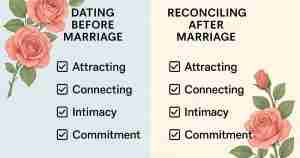
Instead of business interactions, they were free to text, talk, or go out as they wanted.
Texting just to say “hi” replaced questioning and information giving. They also learned to empathize rather than to advise or provide solutions (both of which are business activities).
In addition, Alan and Brittany were encouraged to adopt some of each other’s interests. This gave them something to talk about as well as do together. Alan began reading a book, as that was something that Brittany enjoyed. Brittany learned about football, which was an interest of Alan’s.
They had avoided these activities because they looked at them in a disconnected way. They needed to learn how common activities could create opportunities to get more of what each of them wanted. For example, reading books about places leads naturally to visiting places together—perhaps where there were football stadiums. Learning about football brought more opportunities for socializing with others and with going to games together.
They also needed to learn how to listen and validate without injecting their own opinions and advice. We didn’t need to talk about problems because the lack of emotional connection was their problem. And the changes they made changed them back to a girlfriend-boyfriend relationship again.
Alan and Brittany are a typical example of how coaching can help people make small changes in the way they interact, in order to create big changes in their marriage. Perhaps you can make some of the same changes in your marriage.
Many times couples have difficulty because one person wants more togetherness than the other.
Couples in which only one person has a love language of quality time often have this problem. I’ll leave a link to the love languages quiz on my website in case you want to find out if this could be a problem with you and your spouse.
Let me give you another example where this was a problem and how the couple used good relationship principles and actions to restore love and connection.
Jeremy and June had different love languages.
Jeremy’s love language was quality time, but it wasn’t June’s. Jeremy was often trying to get June to spend more time with him. June liked to spend some time with Jeremy, but she also had other things she wanted to do, both on her own and with others.
Typically people with such differences compromise, which means neither person gets exactly what they want. The result is fair, but it leads to resentment because of the loss that each must continually endure.
This is why I do not like compromise as a solution to differences.
My solution was to help Jeremy and June match better rather than to compromise. The solution included Jeremy working on getting more quality time with people other than his wife. His did this by joining a pickleball club. This met some of his social needs so he didn’t need as much one on one time with his wife.
June learned how to be more positive when they were together. She had gotten into the habit of being negative in order to create more time for herself. She no longer needed to do that, but she still had to develop better habits.
For Jeremy and June, a little social skills training and adjusting their independence level helped them to enjoy their relationship more, to be happier, and to have more to talk about when they were together. No amount of arguing or sharing their feelings would have ever achieved that. They could have spent years trying to convince each other to change—if their marriage lasted that long.
Most people never consider their relationship ending is a possibility until the end is looming right in front of them.

Thinking our relationships will continue no matter what leads to neglect and loss of loving feelings. It’s common for people not to realize how much they could lose someone until they have a life threatening illness or accident, their spouse is dying, having an affair, or wants a divorce.
Part of keeping our love alive is to realize that our relationship is fragile, as are people, and we don’t know how many days we have left. This realization should draw us both to God, our spouse, and others. I’m not saying you need to go around thinking morbid thoughts. But you do have to be mindful enough that you spend the necessary time together and treat your spouse well.
Avoiding future regrets is one of the hallmarks of wisdom and the best way to make decisions.
Don’t take it for granted that your spouse finds you just as desirable as he or she ever did.
Many people change their behaviors a lot after getting married. For example, they may stop being social, stop being in good physical condition, or focus on being helpful. Being helpful is good, but if that is all you have, you will be friend zoned just as surely as you would if you were single. Few single men or women are merely looking for a partner who makes money and helps around the house.
Nor can you be desirable based on what you used to do, or how you used to look. If you are not desirable in the here-and-now, then you are not desirable.
Ask yourself what kind of person your spouse would naturally be drawn to if you were no longer together.
Then, work on being more like that person. Be willing to get outside of your comfort zone as long as you don’t compromise your integrity. Do not let lack of desire stop you from doing what it takes to be more desirable to your spouse. Don’t cheat yourself out of the rewards of a good marriage because you didn’t do the work.
Living on emotional welfare will keep you emotionally poor. Do the work as a couple if your spouse is motivated, or as an individual if only you are. Each positive change either you or your spouse makes for the relationship creates a positive impact on the relationship for both of you.
Every relationship has problems. Close relationships which are characterized by good emotional connection, a desire for each other, and healthy boundaries can deal with these problems as they come, and not get derailed by them. They are bumps and potholes—not mountains and valleys.
Relationships which are minimally connected between people who are minimally desirable are prone to major setbacks when any kind of problem comes along. It’s like living without an emergency fund so that when problems happen they are stressful, impact multiple areas, and take longer to recover from. In fact recovery can be so slow that other problems happen before recovery does. That creates a snowball effect.
Never live or love just enough to get by. Go above and beyond to create a cushion that will ease the impact of bumps and potholes.
You can create such a cushion by using good validation skills, being independently happy (that is being happy whether you are with your spouse or not), staying a good catch, and having secure boundaries. Boundaries also help to protect and promote your relationship.
Did you know that if you sweep your floor every day, it never gets dirty?

The alternative is to clean your floor only after it gets dirty. Do you know the difference between these two strategies? The first way prevents ever having to have a dirty floor. The second means having a dirty floor every week. In the same way, people who maintain their relationship daily, enjoy a continually satisfying relationship. Waiting for problems to happen, before you work on connecting, ensures that you will regularly be disconnected.
If you prefer the smooth ride to the roller coaster ride, starting putting to use all the ways you have learned to make your marriage better. If you have learned three, as I have presented here, then do all three. Start with one and then once you get that going, add on another. Build the cushion for a smooth ride.
If you’ve run out of ideas and your ride still feels like a roller coaster, then it is time to learn (and do) more. I would be happy to help with that. You can work with me in individual coaching or together with your spouse in couple’s coaching. We will work on the behavioral changes needed for a close relationship.
I want you and your spouse to enjoy your relationship for as long as you have it. I want to help you learn to live without regret by being the loving and secure person which will help you to feel good about yourself, while getting more love from your spouse.

Learn more about the value of working on behavior change as a couple:
Jacobson, N. S. (1992). Behavioral couple therapy: A new beginning. Behavior Therapy, 23(4), 493–506. https://doi.org/10.1016/S0005‑7894(05)80218‑7 (academictree.org)