How to Have More Empathy for Your Spouse
Empathy in marriage is one of the most important ways to emotionally connect. In fact, it’s almost impossible to reconcile or maintain a marriage without it. Today, I will help you to empathize better with your husband or wife.

Let’s start by defining what empathy is.

Most people think of empathy as being “nice” or listening with “understanding.” However, it’s possible to be both nice and understanding without empathizing at all. I have coached many nice men and women who were losing their relationships for lack of emotional connection. I have also worked with many people who have learned to listen better, often from marriage counseling, but who nevertheless failed to create connection in their marriage.
Being nice and being a good listener are important qualities for relationships.

They are the water and soil of good relationship. Empathy, or more precisely validation, is the sunshine that makes the relationship grow. No matter how good your soil or how much you water, you are still going to need the sunshine of validation to make your relationship grow.
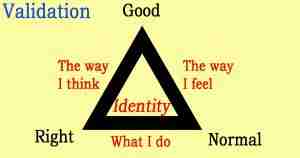
Learning how to validate your spouse with empathy requires sensitivity to your spouses feelings and not mere understanding of his or her words. Being nice communicates the message “I am a good person.” Being a good listener communicates “what you say is important to me. Empathizing communicates the message, “you are normal, your feelings are right.” When it is communicated well, it creates emotional connection.
Did you know that all emotional connection is the result of matching?
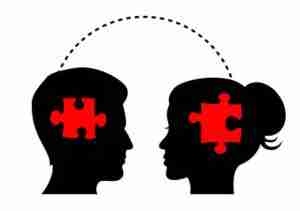
Empathy creates connection by creating a match in a way that being nice or being a good listener does not. If you tell me you love to read and I buy you some books, then I am being nice. I may get appreciation for my efforts. If you tell me you love to read and I reflect that back to you by telling you how I understand you like to read, you will know I have heard you.
But, if I say I like to read too, then I have created an emotional and activity match between you and me. We both read and we both like to read. It doesn’t make me nice. It does reflect good listening, but it also makes you feel that we are similar. Similarity and complementarity are the essence of matching and creating emotional connection.
Complementarity simply means who you are matches who I am, even in our differences.

For example, if you like to talk and I like to listen that makes us different, but it also makes us match. Non-complementary matches always create disconnection. For example, if you are an extrovert and I am an introvert. No amount of understanding that difference will overcome it. We will have to compromise and lose some connection to make the relationship work.
Let’s explore other examples. I like to stay in nice hotels and so does my wife. She is Christian and so am I, we both like to garden and hike, we are both relationship coaches, and so on. Sometimes it feels like the main difference between us is our hairstyles. Our relationship is very emotionally connected. The more people match to each other, the stronger their emotional connection will be. The amount of similarity you have before marriage is the best indication you are a good match. The extent that you stay similar after marriage predicts whether you will continue to be together.
Being good at all validation, including empathy will help you to have a long and loving marriage.
That’s true even if you are not such a good match now.
Let me talk about an example to show you how this can be.
Suppose you like to stay in nice hotels, but your spouse does not like to spend money on them. That is a difference of course. It’s not complementary because you can’t stay in a luxury hotel and save money at the same time. And, no matter how much your spouse works to convince you that staying a cheap hotel is a better option, it won’t make you like cheap hotels any better. You can understand the reason to do it, but you still won’t have the desire to do it. Understanding, alone, does not create emotional connection.
Sometimes getting people to understand us can help them to see we are similar. And sometimes, it just makes it clearer how different we are. I recommend you reserve getting your spouse to understand you for when you believe your spouse is actually similar to you. Self expression is good only to the extent it is helpful. Harmful self expression is not the Christian way, only feels good while you are doing it, and has a bitter aftertaste of regret.
Don’t fall for the lie that openness and honest are the way to a good relationship.

It is actually being loving and honest, not open and honest, which will get you there.
I frequently help my clients practice variations of agreeing and empathizing so that they can both eliminate conflict and create stronger emotional connection. One principle for when to agree and when to empathize is that we agree with ideas and we empathize with emotions or emotion provoking events.
So, your spouse saying “we can save money by going to a cheaper hotel” is an idea. It is not a feeling. You could agree with the truth of this idea, without actually having to stay in a cheap hotel. Agreeing with our spouse’s point in no way obligates us to do what he or she wants, but it does make our spouse feel right. Work to make your spouse feel right while maintaining good boundaries.
This is a skill which I wrote about in my book, Connecting though Yes!. It is both a marriage building and a marriage saving skill.

We can say for this example,
“Yeah, staying in a cheaper hotel would give us more money for doing other things.”
Or, imagine that instead your spouse said, “I get nervous when we spend a lot of money.” This expresses mainly a feeling. Empathizing would create more connection than agreeing. How could you do that for this example? Well, you could say something like, “I think a lot of people feel the same way.”
Saying this also doesn’t mean you have to stay in a cheap hotel, but it helps your spouse to feel normal. Remember that validations helps people to feel either normal or right, or both.
Saying, “Don’t worry–we can afford it,” is reassuring, but does not increase similarity and so doesn’t improve connection. It gets you through the moment, but it doesn’t get you further ahead.
We can also empathize by letting someone know how we are similar. Perhaps the easiest way to do this is to simply say things like, “me too,” or “me either.”
Suppose your spouse said, “I don’t like it when you don’t remember what I say.”

An empathetic response could be, “I don’t blame you. I don’t like it when people don’t remember what I say either.” This is a non-defensive, validating response, which does not escalate conflict.
Conflict does not help to build relationships and is an indication of problems, not progress. There is no such thing as healthy fighting. Don’t fight; don’t avoid either. Validate and use boundaries when necessary. It’s a game changer.
Whether to agree or to empathize is a judgement call. A good rule of thumb is to empathize whenever emotions are strong, and agree when the other person is being more rational or logical.
Pay attention to body language and tone of voice.

Even people who don’t talk about feelings show how they feel with their tone of voice and body language. If you can tell what people feel from their facial expression, you already have some empathy skill. If that is hard for you, you can learn to do it. Picking up these cues will help you to make and keep relationships.
Another thing you can do to get better at empathizing is asking questions of yourself. This is what self analysis is. People tend to focus more on what they want to say than on how their spouse will receive their message. Questions can help you shift the focus from what you want to say to the kind of reaction your spouse is likely to have.
It will do you no good if you are good at communicating clearly, but miss the emotional impact of your words, your body language, and your tone of voice.
Get in the habit of asking yourself questions before you say something to your spouse, whether in person or by text.

Here are some good ones:
- How will my spouse feel if I just say the facts?
- How can I say it in a way that my spouse will be more receptive?
- What tone of voice would be best to use to convey this message?
- How can I say it in a way that my spouse will like at least some of what I have to say?
- Does my message indicate something good about my spouse or make my spouse feel we are similar?
Consider these two messages:
Message 1: “You are always working and never want to go out with me,” (said in a harsh tone of voice).
Message 2: “I really enjoyed the last time we went out. Can we do that more?” (said with a nice tone of voice).
While both messages express the idea you want to go out more often, the first one is critical and will cause defensiveness.

The second one is expressed in a way that is likely to be received better, helps your spouse to feel better about you, and makes it more likely you will get you what you want.
Put yourself in your spouse’s shoes before speaking or responding. Think how you would feel if your spouse said to you what you want to say to your spouse. Find a better way to say it. If you combine that with helping your spouse to feel appreciated and to have a good time with you, your relationship will build. You will have better emotional connection in your marriage.
If your spouse does not enjoy talking with you, then you have either been focusing solely on the information you are providing or are saying things in a way your spouse doesn’t like. Work on both message and delivery to come across better and build your marriage. Sometimes you can improve the tone of your text simply adding an emoji.
Learning how to improve communication in marriage is about checking off the steps.
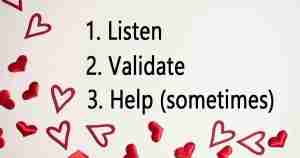
Listening is a first step, like putting on your shoes before going outside. But, you have go another step in order to connect, just as you have to actually walk out the door to get outside. Listening is putting on your shoes. After that, you need to take a step or you won’t get anywhere.
For example, if your spouse says, “I don’t feel like I’m important to you” and you reply, “I understand you don’t feel like you are important to me,” you have prevented your spouse from needing to repeat it but you have in no way provided validation. Your spouse won’t know if you think his or her concern is valid.
You could invalidate your spouse by telling her she is wrong, or reassure her that her feelings are wrong. Either way, it will not create connection.
Instead, you could ask a clarifying question such as, “why is that?” Y
ou could then validate what she says.
It might go something like this:
Your spouse says, “I don’t feel like I’m very important to you.”
You ask, “Why’s that?”
Your spouse clarifies: “Because you don’t spend time with me anymore.”
Then, you can empathize by saying: “It’s no wonder that you don’t feel important if I’m not spending time with you, I’d feel the same way if you didn’t spend time with me.”
People without good relationship skills, don’t clarify, become argumentative, give explanations, promise to do better, or even blame their spouse.

This turns an opportunity for connection into another incident of disconnection and more emotional distance.
Which do you do?
In case you missed it, listening comes first, validation second, and if you are going to help or fix, that comes third.
If your spouse says, “I don’t feel like I’m important to you,” and you immediately jump into fixing mode by saying “what can I do to make you feel more like a priority?” you have skipped an important relationship building step. You have not validated your spouse’s feelings. You just want to fix his or her feelings. While that may get you appreciation, it will not help to connect you. If you are a fixer, you may have seen how all that fixing has actually just resulted in more distance.
Simply listening and fixing will not create emotional connection.
You have to have that middle step of empathizing as well as spending quality time together, sexually and nonsexually, in routine activities and special ones.
A good marriage is a lot of work. A bad marriage is even more work. Don’t expect no-cost love-handouts from your husband or wife.
Strive to validate your spouse rather than to improve, advise, correct, or reassure him or her. Spouses have affairs in order to get validation and/or sex. No matter what else you are doing, you had better be providing both of these things if you want to stay together. And be a cheerful giver. God doesn’t want us to be reluctant givers. No spouse wants to be reluctantly loved, either.
Does your spouse want to be with you more than with anyone else?

If not, then why not? Your answer to that is the key to getting more love and affection from your spouse. The answer will have to do with what you say , how you say it, what you show, and what you do, both when you are together and when you are not.
You can have a closer relationship by changing:
- What you say,
- How you say things,
- What you show, and
- What you do.
By being more of the kind of man or woman your spouse wants to be with, your spouse will desire to be with you more. Learning to empathize well, along with agreeing, being secure, and being otherwise similar can start new relationships and fix old ones. The better you are at these skills, the faster your relationship will grow.
Fewer people have these skills than you might think.

They are hardly taught or modeled anywhere and most of us did not learn good relationship skills from our parents. I certainly didn’t. I had to learn them all as an adult. If you need to become better at these skills, I’d be happy to help. See my Re-Connections Coaching Package to find out how we can get started working together. Let’s improve your marriage by putting the rights steps in the right order for rapid progress.


Want a deeper dive into empathy?
Cuff, B. M. P., Brown, S. J., Taylor, L., & Howat, D. J. (2016). Empathy: A review of the concept. Emotion Review, 8(2), 144–153. https://www.researchgate.net/publication/272202633_Empathy_A_Review_of_the_Concept