

How to Solve Marriage Problems Without Arguing
Updated August 4, 2026
Are you frustrated that trying to solve a problem with your spouse either leads to avoidance or conflict? The method you use will determine the results you get. Let me help you with some conflict-free ways of solving marriage problems.
How Conflict-Free Problem Solving Can Strengthen Your Marriage
Can you imagine how much your relationship could be strengthened if you and your spouse could solve marriage problems without arguing? It is entirely possible, and there are several good steps that you can take on your own toward conflict-free problem solving.
If your relationship is still fairly strong, I recommend starting with the ideas I am giving you today. If you have multiple problems and a distant relationship, you may need some expert help to put the right steps in the right order. I will give you some resources at the end of this post.
The first positive change you can make is to stop trying to convince your spouse that there is a problem. Why is that?
It is because…

Convincing has nothing to do with problem solving
Convincing is what leads to conflict. Stop the convincing, and you will stop the conflict.
Specifically:
- Don’t try to convince your spouse there is a problem.
- Don’t try to convince your spouse that he or she needs to change.
- Don’t try to convince your spouse that you have a better way.
Too often, people try to solve marriage problems by convincing their spouse that there is a problem, partially or mostly caused by their spouse and that their spouse needs to change. This causes a defensive reaction either in the form of defending, attacking, or shutting down. Essentially, your force meets your spouse’s counterforce and stalls the process.
Of course if you can use an overwhelming amount of force by either a barrage of logic or emotion, you can get your spouse to change. This change usually comes at the cost of emotional closeness. So, the more problems you solve by your bombardment of logic or your hysterics, the worse your relationship will be.
As a coach, I teach people on both sides of this battle. I teach people who are bombarded with criticism from their spouse how to handle it non-defensively, and I help people who are trying to solve problems this way to use a better way. Since the people who come to me want to save their marriage, these are important skills.

As a Christian, criticism and arguing are simply wrong. In the words of our Lord, Jesus Christ:
“Blessed are the peacemakers, for they will be called children of God (Matthew 5:9, NIV).”
Be sure to pray for God’s guidance in how to lovingly resolve any marriage problems you have. Also, pay attention to any resources He leads you to. He is unlikely to just miraculously make your problems go away. He wants you to learn and to trust. Both are aspects of becoming wiser.
How to Solve Marriage Problems Without Conflict
If you are like many people, you just do what feels natural because you grew up with parents who did the same thing. Ending conflict by using secure and loving methods feels very unnatural to people who are not used to doing them. For you to solve problems better, you must solve them in ways that feel unnatural. As you have success, they will start to feel more natural.
Here are some transition steps you will need to make. If you are already doing some of these, then it will be easier.
You must begin to:
- Consider whether to bring the problem to your spouse or deal with it on your own.
- Consider what aspects of the problem your spouse would be motivated to solve.
- Listen and validate your spouse’s solutions and concerns before presenting your own.
- Be willing to try your spouse’s solutions before trying your own–even if yours are better.
Whether you are a logical or emotional person, these steps will feel unnatural. You may just want to solve things quickly and logically, or you may just expect your spouse to be concerned because you are. The truth is we must talk as carefully to a spouse as we would to a friend or coworker. We need to validate them and look for win-win solutions. We must put the relationship ahead of expediency in most cases.
Of course if there is an emergency, your spouse will be as motivated to put out the fire as you are. But don’t go making an emergency out of something which has been bothering you for two years.
When should you bring a problem to your spouse?
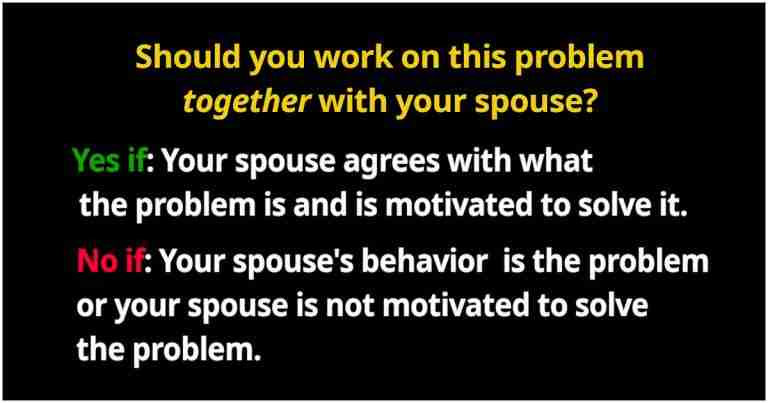
Some problems are best dealt with without your spouse. The rule is to only work on problems with your spouse when your spouse is in agreement with what the problem is and also wants to solve it with you. If your spouse agrees that something is a problem, but tells you to deal with it, then do just that.
Contrary to popular belief, it does not take two to solve marriage problems. One person using either marriage-building behaviors and/or good boundaries can restore a loving relationship. I have been helping people do that for years with people who have destructive spouses, cheating spouses, and rejecting spouses.
If your spouse does not agree with the problem, does not want to solve the problem, or is the problem, then don’t try to get your spouse to work on it with you. Your spouse’s lack of motivation will create conflict, avoidance, or your spouse will not follow through on any solutions you come up with together.
Example: lack of emotional intimacy in your marriage
For example, suppose the problem as you see it is that your interactions have become too businesslike and the closeness has gone from your marriage. You would like to work with your spouse on becoming close again.
First, ask yourself, “Do I think my husband/wife also thinks this is a problem and that we should work on it?”
If you are sure your spouse has the same desires and concerns as you, all you have to do is approach your spouse and say, “Let’s come up with some ideas for being a closer couple again.”
If you are not sure your spouse has the same desires and concerns as you, then try to indirectly feel it out. Perhaps say something to your spouse like, “It seems like we are getting into a routine. Do you ever miss the old days when we used to just hang out more together?”
Your spouse’s answer or lack of answer will clarify whether your spouse has the same concerns and desires or not. If your spouse is unresponsive, take that as not being on the same page. Don’t push for a response.
If you are sure your spouse does not have the same desires and concerns as you, then do not approach your spouse with this problem. That would lead to even more distance in your marriage. Instead, work by yourself to come up with ideas that would motivate your spouse to have the same desires and concerns.
For example, you could:
- validate your spouse more,
- work on being more attractive,
- work to become less available,
- develop hobbies which overlap your spouse’s interests
As a result, your spouse would enjoy interacting with you and seek to be more involved with you. Some people do the opposite and become critical, cold, and distant. These behaviors would not motivate a spouse to spend more time together. They would just make the current problem worse.

Working with your spouse
Suppose your spouse does have the same concerns as you and also desires to find a solution? Do not be quick to tell him or her your idea about how to improve things. The reason is that although you may have a great solution, it may not be immediately appealing to your spouse. Instead, solicit ideas from your spouse, then offer two or three of your own, including the one you think is best (without saying that you think so).
There are several benefits to this. One is that people are more open to new ideas if they can’t come up with ideas of their own. Or if they have the same idea as you, then you can easily validate their idea. I recommend you make your spouse feel like it was his or her idea, even if it was yours already. Making your spouse feel good about his or her idea is more important than getting credit for having already thought of the same thing.
Another benefit of soliciting ideas rather than presenting solutions is that sometimes your spouse will have a better solution than you do.
Be prepared to try your spouse’s solution before yours
Suppose you and your spouse have come up with several possible things you could do to solve the problem. I recommend you aim for at least five. Consider the pros and cons of each solution. If you can’t come up with pros and cons for each solution, then you haven’t clearly thought them through. Every solution has both positive and negative aspects.
A solution such as “go out on a date once a week,” may sound like a foolproof solution for becoming closer, but for many people, dates are just another part of the routine. Or, dating time is spent either in a non-interactive way or talking about kids and business.
What you should end up with is not a perfect solution, but one that you think is likely to work better than the others and that you both are willing to try as an experiment. If you and your spouse are divided on what to try, then try your spouse’s solution first. Otherwise, you can have a conflict over which solution to try.
Make a backup plan at the same time you both agree on the solution

Never assume a plan will work, no matter how promising it sounds. Instead, whether working with your spouse or not, choose a backup plan in case your first solution does not work. If working with your spouse, a backup plan will help to keep your spouse motivated with your initial solution. For example, if your Plan A is going on more dates and your Plan B is attending a marriage retreat, your spouse may be much more motivated to go on dates with you, partially to avoid having to go to a marriage retreat.
If you and your spouse have tried Plan A for a month and it’s not working well, your spouse is likely to be more willing to go on to Plan B. So, if the dating is not working, your spouse will be more willing to go to a marriage retreat. At that point, you need a new Plan B, which may be going to marriage counseling. Your new Plan B will help both of you to follow through with your new Plan A.
What if the marriage retreat didn’t help? Then marriage counseling would be your new Plan A and perhaps a marital separation would be your new Plan B. As you can see, each new Plan B is worse than the one before, which is very helpful for solving problems.
If you are working without your spouse, follow the same method:
- Brainstorm several ideas,
- Consider the pros and cons,
- Choose one as your Plan A,
- Choose another as your Plan B.
With this method, you never have to be desperate or feel hopeless. You are also far more likely to be successful since you didn’t get stuck with just one solution. For many people, their only solution is to discuss problems with their spouse. Then, if that doesn’t work, to feel frustrated while continuing to try the same solution. Eventually, this leads to negative behaviors, hopelessness, and giving up.
As far as working on problems you believe are caused by your spouse, discussing them with your spouse is one of the least effective things you can do. Better choices would be validating more, increasing personal desirability, making positive requests, increasing independence, and using boundaries. These can create changes without creating conflict.
When you solve marriage problems this way, your relationship will become closer
Solving marriage problems without arguing may be something that you can achieve on your own as long as you go gradually and don’t get down on yourself when you mess up. Changing takes time and it takes messing up, too.
Many people will just need some examples of how to solve problems in order to make progress. My book, Connecting Through “Yes!” presents the problem-solving method in more detail. It also includes many examples of how to use agreement while still solving difficult problems. Example issues covered are finances, parenting, affairs, separations, addictions, and so forth.

You may need to get professional help if your situation is complicated by multiple problems, a strained marriage, or if you have exhausted your ideas for improvement. In such situations, you can either do more of the same, feel hopeless until you give up, or get help from someone experienced in problem resolution and marriage improvement.
My coaching package, Restore a Loving Relationship with a Difficult Spouse, can help you to get from a place of feeling stuck to making progress in your marriage again.
Learning conflict-free problem-solving methods is virtually risk-free. The only regrets my clients ever have about learning these methods are not having learned them sooner.

FAQ
Shouldn’t we be able to discuss everything with our spouse?
In an ideal world, yes. But we live in a fallen world. This means we need to have locks on our doors, be cautious with strangers, and be careful not to make our spouse feel attacked. Some spouses are truly non-defensive and easier to discuss things with. See who you or you spouse actually is, and deal accordingly. Don’t expect a normally defensive spouse to become good at listening to problems you bring up.
Isn’t it normal for spouses to argue?
If you define normality by what the majority does, then arguing is normal. If you define normality by what is healthy and in line with the Bible, then arguing definitely is not normal. Successful people are always in the minority and do not do what the majority do.
Aren’t there some problems which cannot be solved?
Yes there are. But, we don’t know until we have done everything we can to solve them. If a problem can’t be solved, then we must accept that and decide whether we will live with it or end our relationship. The only other choice would be continued conflict, which is not desirable by God or humans.
For further study:
Overall, N. C., & McNulty, J. K. (2017). What Type of Communication during Conflict is Beneficial for Intimate Relationships?. Current opinion in psychology, 13, 1–5. https://doi.org/10.1016/j.copsyc.2016.03.002


