
No Contact or Low Contact? Get it Right for Reconciling with Your Spouse
The right amount of contact is critical for reconciling with your husband or wife. Opinions vary widely on how much that is. Today I will help you to determine just how much contact to use for your particular level of marriage problems. Getting it right, will help you to confidently work toward preventing divorce and reconciling.

Why pursuing more can push your spouse away
A few popular books would have you greatly increase the time and attention you give to your rejecting spouse. The idea is that you will win them over with your consistent show of love. These books are a match for spouses who still have some hope for marriage improvement. However, if your husband or wife has checked out of your marriage, your pursuit will appear self-serving and manipulative. It will push your spouse away rather than drawing him or her toward you.
Failing to pursue when your spouse wants to be pursued, or pursuing when your spouse doesn’t want to be pursued will both cause distance. Timing is important.
Your spouse’s experience matters more than your intentions

When working on reconciling, it is important to consider not only the amount of contact we have, but the current state of our relationship. I help my clients to get this right, because it is one of the major keys which helps them to reconcile. Now, I will help you to learn when to initiate contact, how much to initiate,and when to end each interaction to grow your spouse’s desire for you.
Why too much time together weakens relationships
When people begin new relationships, there are two times that are critical to relationship development: time together, and time apart. While that may sound obvious, very few people realize the truth of it. Most people think the more time you spend together, the better. However, too much time together actually slows down relationship development and makes it more likely the relationship will end.
In Ecclesiastes, Chapter 3 the Bible tells us that there is a proper time to do and not do things. A part of wisdom then, is knowing when to pursue and when to take time apart.
How to be enjoyable instead of draining
When we are together, how we interact is vitally important because it will partially determine how much our spouse looks forward to being with us next time, and the next time, and on and on into the future. With the right amount of interaction and the right type of interaction, our relationship will stay strong and stable, we will enjoy being with each other more, and our love for each other will be more intense.
On the other hand, if we have too much interaction or interact in an undesirable way, our spouse will feel relieved to have time apart. Then we will come together before getting distance again. Our marriage will be a roller coaster ride of positive and negative time, with the negative time growing longer and longer as our relationship continues.
In a nutshell, if you are unenjoyable or spend too much time together, your spouse, just like other people, will want to get away from you. If that’s the case, you need to fix these two behaviors by learning to be more enjoyable and by getting your timing right.
A restaurant analogy: how to avoid being overwhelming
The ideal situation is to enjoy being together without any neutral or negative moments, and to end each interaction on a good note. Consider service in a fine restaurant. You want to have pleasant and helpful interaction with your server, and to be left to enjoy your meal the rest of the time.
A pleasant server can become unpleasant either by not being there when needed or by interrupting your meal too often. Just like a good server, you need to be attentive to your spouse’s reactions to you. The good husband or wife pays attention to the experience of their spouse.
What desirable spouses consistently do
The desirable spouse is:
- Attractive,
- interesting,
- interested,
- validating, and
- enjoys their life even when their spouse isn’t around.
If you were single, these would be the characteristics you would make sure you had in order to attract and keep the best partner. They help the other person to enjoy you and develop feelings for you. They are the same characteristics you need to re-attract a rejecting partner.
What undesirable spouses unintentionally do
The undesirable spouse:
- Behaves in unattractive ways
- has poor self-care,
- has no passions or hobbies of their own,
- doesn’t show interest in their spouse,
- may be helpful, but doesn’t validate,
- spends time together only when he or she wants to, regardless of what their spouse wants.
How to know when you’re initiating too much

New clients often ask me questions like, “How often should I text my spouse?” The answer to that is “Less than he or she wants you to.” This same principle applies to phone calls, dates, and every other interaction. If you text your spouse five times and your spouse stopped enjoying your interaction after two, then you have texted too much. You would be like the server who keeps going back to the table when unneeded.
Knowing how much time or interaction someone wants is simple. You only need to see how they react to you when you initiate the interaction. An unfriendly response or unfriendly body language means, “I don’t like this initiation.” A neutral response means, “your interaction is okay, but not something I was looking forward to.” Neither of those two responses are good for building relationships.
Why feelings intensify with the right amount of contact
Too much time together creates neutral or negative time which detracts from our enjoyment of each other. When this happens only once in a while in a good relationship, no tragedy is going to happen. But, in a new relationship or one that is badly damaged, this added neutral or negative time prevents the intensification of feelings.
Feelings intensify when we get a sample of a desirable interaction or experience, but less than we want. We will have more of a desire to be with that person again soon, they will be perceived as more attractive, and our feelings of love will grow faster.
The three conditions that build desire
Now, you need to note the conditions for this intensification of feelings to happen.
- It must be a good experience.
- It must end while it is still enjoyable. And,
- it must not be readily available.
This creates feelings of anticipation and desire. Too much contact will prevent that. Note that you still have to have some contact. Otherwise you can’t create a good experience.
How scarcity and satiation impact attraction
I know it’s hard to reduce contact with a spouse you love. But, being able to give the right amount of attention and affection can make the difference between keeping and losing your spouse. So hang in there!
Remember that too much of a good thing is a bad thing. Too little of a good thing is also a bad thing.
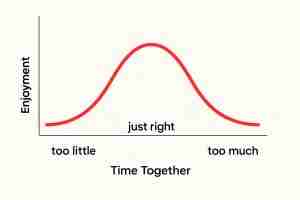
The right amount of a good thing is what takes care of the desire without creating satiation. Getting stuffed on a fine meal will not make you want to have another one soon. The right amount stops the hunger, but does not completely fill you up.
Common feast-or-famine mistakes that damage marriages
Some people create feast or famine situations, damaging their marriage with both aspects. They do this by spending too little time together on a regular basis (too little of a good thing). Then, they spend an excessive amount of time together (too much of a good thing). Both push them further apart. A good example of this are couples who don’t spend daily time together or date, but then go on long vacations in which they are together all the time. This pattern will not end well.
Why needy behaviors ruin even good interactions
Any amount of a bad thing is a bad thing.
Any bad behavior on the part of your restaurant server can spoil your experience. Likewise, you behaving badly only one time out of ten is enough to take away all the good you have done. Cut out the needy behaviors.
Needy behavior has nothing to do with dependency. needy behaviors are unpleasant behaviors such as criticism, unwanted explanations, arguing and overstaying your welcome.

End every interaction while your spouse is still enjoying you
Your friends want to see you, but they don’t want to see you all the time. Neither does your spouse. Or even your dog. End every interaction while the other person is still glad you called, texted, went out, or stopped by. Then the other person will look forward to being with you again. Their desire for you will grow.
Small, enjoyable interactions are the key to longer, committed, and re-committed relationships.
How this applies to reconciling with a rejecting spouse
Now, let’s apply this to a reconciling a situation. Most likely your spouse has had many bad encounters with you and is not particularly looking forward to your next interaction. If you start to hang around your spouse more at this time, your spouse will want to get away from you very strongly. His or her feelings for you will get even worse.
You can’t compensate for an excessive amount of bad behaviors with an excessive amount of good ones.
Why no-contact rarely works for reconciliation
What if you go no-contact? First off, who wants to do that? I know you are willing to if it will help you reconcile, but fortunately it’s not necessary. If your spouse no longer likes you and is stressed by you, then having no contact will certainly help your spouse to enjoy the break from you. But, it won’t give him or her any new experience with you.
Why the friendship-only zone leads to divorce
What if your spouse likes you enough to want to be friends, but not enough to want to be married? That is a common situation that promotes divorce if not handled correctly. Will going no-contact in this situation be helpful? Well, at first it will create more of a desire for interaction. But, then if you don’t interact, your spouse will feel rejected. If you do interact, your spouse will be reassured and enjoy being with you, but still on the path to divorce with friendship.
Then, what will you do? Will you go no-contact again? If you do, you will find that this stops working after a while. Your spouse will adjust to having less contact, will enjoy your get togethers, and will learn that your absence doesn’t really mean losing you. There is no way to create commitment this way.
Why commitment requires the possibility of loss
People only commit when they have to, in order to keep someone valuable that they would otherwise lose. If there is no chance your spouse is going to actually lose you, there is little chance your spouse will actually commit to you. It won’t be necessary.
When no-contact works—and why it usually doesn’t
So why do some people recommend going no contact to reconcile? Because sometimes it works. But, and this is an important “but,” it only works with needy spouses who are doing an intervention.
What does that mean? It means if a needy man or woman is trying to improve the relationship by being distant or threatening divorce, they definitely don’t want to lose the marriage. Then, if their partner goes no contact, they become very fearful of abandonment and become very nice and loving in order to prevent abandonment.
Fear-based love versus real connection
Fear of abandonment causes intense loving feelings. Just think how much more strongly you feel in love since you discovered you might lose your spouse. That intensification of your feelings doesn’t come because your spouse is behaving better towards you. In fact, your loving feelings have intensified because your spouse is rejecting you.
These fear based feelings go away once the fear does. When people are reassured of a continuing relationship, behavior reverts to the way it was before if no other changes are made.
The destructive cycle of fear and distancing
Without real change, a pattern of fear-connection, distancing-rejection can occur repeatedly. Some people have many years of such roller coaster relationships. However, there are some major problems with this:
- The marriage is never improved except for brief make-up periods, followed by worsening relationship.
- Feelings of hopelessness are created since things don’t really improve and the same old pattern is repeated.
- This pattern ends when the needy spouse finds someone else to attach to. Then, the fear of abandonment is gone and going no-contact will no longer be effective.
The better strategy: low contact with enjoyable interactions
So, can going no-contact be helpful? Yes, but only with a needy partner or one who wants to remain friends. However, just like lighting a match, without additional fuel the effect will be short lived. A better strategy is to reduce contact below the level your spouse wants. Let him or her get an appetite, but not starve. Have good interactions, but end them while your spouse is still enjoying you. Use the time you are apart to enjoy your life and otherwise be attractive.
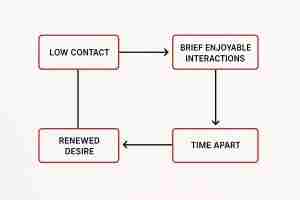
How to become the person your spouse doesn’t want to lose
This is the process that I help many people do to rebuild their relationships and prevent divorce. If you are currently pursuing your spouse with more time and attention, take a close look at whether that is actually helping. If it is causing your spouse to be more critical and rejecting, continuing to pursue will just get you more rejection. Eventually you will give up out of self-preservation.
That does not have to happen. You can become the person that your spouse does not want to lose, but feels they could. You can interact in a way that leaves your spouse wanting more. This is not a game–it is the natural way that relationships are formed when we first meet someone. It is also the way relationships are rebuilt when they have broken down.
Work with me one-on-one to rebuild your marriage

Work with me one-on-one by getting my Re-Connections Coaching package. I will help you to re-create the same conditions that enabled your spouse to fall in love with you in the first place. Stop thinking about how to get your spouse to do what you want and start working on being the kind of person your spouse wants to keep. That is what will truly keep you together in a positive, happy marriage.


For further study:
Hogan, J. N., Crenshaw, A. O., Baucom, K. J. W., & Baucom, B. R. W. (2021). Time Spent Together in Intimate Relationships: Implications for Relationship Functioning. Contemporary family therapy, 43(3), 226–233. https://doi.org/10.1007/s10591-020-09562-6