Why Trying to Fix Your Marriage Might Be Making Things Worse
When a spouse wants separation or divorce, many people try to fix problems directly. This usually just results in more distance. Here’s a way that is easier and works better.

The Common Pitfall: Trying to Fix Instead Validating

One of the biggest mistakes people make when trying to repair a strained relationship is treating it like a practical problem to be solved. Using practical solutions for emotional problems is a real mismatch that can only result in frustration and distance. Maybe you are feeling that now. While fixing has it’s place, it doesn’t heal feelings or create connection.
Practical solutions lack empathy or agreement. They make people feel like you just don’t get what they are going though, even if you intellectually understand the decision they are making. Robots will never be good nurses or therapists because they just can’t feel what we are going through. Logic and helping miss the mark.
What’s wrong with being helpful? Being helpful, when help is wanted, creates appreciation. When a person doesn’t want your help, it creates rejection.
Here is a nicely worded message that falls flat: I know you don’t want to stay in this marriage. What can I do to help you want to stay?
While it shows understanding it also creates more emotional division by offering unwanted help. It also will create anger if you could have helped before and didn’t. Your wanting to do it only after your spouse is done with you comes across as more for you than for your spouse.
Listen again to this statement which offers help:
I know you don’t want to stay in this marriage. What can I do to help you want to stay?
And now this one, which offers no help, but is empathetic:
Our relationship really has become distant. I can’t blame you for not wanting to go on like this. In fact, that wouldn’t be good for either of us.
This statement shows understanding, but goes beyond it. Understanding is never enough for rebuilding. By expressing some overlap between your spouse’s thoughts and feelings and yours, you create connection. You actually start to fix your relationship by not trying to fix your spouse’s feelings.
One blade of grass doesn’t make a golf course, and of course there is a lot more work to do.
Empathy is the starting point for all relationship building.
Even if your spouse wants you to fix, to care, and to reassure, without validation these three responses lead only as far as the friend zone. Going beyond that requires a similarity at both a surface level and a deeper one. Helping and understanding don’t create that.

There is a big difference between understanding and validation. One leads to the friend zone, while one helps to reconcile.
To rebuild, change from fixing to validating
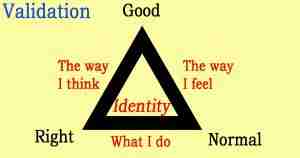
Validation is the process of making people feel normal, right, or good about the way they think, feel, or behave.
When you say, “I understand you…” it doesn’t do any of these things. I teach my clients to avoid saying “I understand.” The only time to say I understand is when you add to it, “because I feel the same way.” Those last words prevent creating the difference between you and your spouse that happen when you express understanding only.
Five validating behaviors are: agreement, empathy, compliments, appreciation, and admiration. I commonly help my clients to be excellent at these skills since they are key to creating emotional connection.
Things to avoid when validating

Some people validate, but then immediately follow with fixing. The hard thing for the fixer is to stop fixing altogether. They feel like something is missing if they don’t offer a solution or advice, or start brainstorming ways to fix things. They are caring rather than connecting and create more of a parental role for themselves than the boyfriend or girlfriend figure they need to be to reattract their spouse.
When you validate,
Leave out the “buts“
I agree with you, but…
I love you, but…
I know what you mean, but…
When you add a “but,” you add a difference between you and the other person. If you validate first, you score a point with the validation and then lose a point with the “but.” That makes your net gain a zero. If you don’t validate first, then your “buts” will make you lose a point without gaining any–putting you in the negative.
Don’t replace “but” with “and.”
I know some people learn to replace but’s with and’s, but the and’s typically are some practical step which shifts a love-building statement to a friend-building one.
I love you and I want to take you on a cruise, has far less emotional impact than if you split this into two statements with some time in between them. Tell him or her your loving feelings now. Then shut your mouth. Talk about the cruise later.
Your “and” comment will distract from the emotional connection created by the validation.
Maybe this example will make it clearer–I love you and we need a gallon of milk.
Another thing not to do is to not explain.
Don’t explain

Explaining when not asked to is an insecure behavior. It is a common behavior for needy people.
I love you because … (and listing your reasons) has a good chance to backfire if your spouse doesn’t like just one of you reasons.
Saying, I haven’t been enjoying this relationship either because… (followed by your reasons) is likely to lead to conflict rather than connection.
If you like to explain, observe how often it creates a good result vs a neutral or bad one.
Experience is an excellent teacher that must not be ignored in favor of long held false beliefs.
Don’t apologize
I agree this relationship isn’t very good. I’m so sorry I didn’t spend time with you when I should have and called you pigeon toes and pumpkin nose and …
Reminding someone of the things you did wrong is not a way to connect. It is a way to make them feel better about distancing from you. There is a place for apologizing, but it needs be done separately from validation so that you don’t lose the impact of your validation message.
Don’t promise to do better or to work on yourself
If you do that, you are going back to fixing mode.
I will fix myself so that you will feel better.
This probably comes too late, possibly will get you appreciation, but definitely will not connect you. I’m all for doing better. We couldn’t grow without working on doing better. However saying that we are going to work on ourselves is a promise that sets us up for blame and broken trust if we mess up just once after promising. Changing, rather than promising to, is what helps people to see us differently.
Don’t tell your spouse that you will stop fixing–just stop fixing. And gradually start to validate. The combination of stopping a bad behavior while gradually adding relationship building behaviors is key to reconciling.
Don’t ask for more time
Asking for time takes away from validation. If your spouse wants to take more time, then agree with it and you will be validating. But, asking for more time when your spouse wants to move on is being different, so is invalidating and will create more distance.
Differences create distance. If your spouse wants to move on and you express that you don’t, you only create distance. You don’t stop your spouse from moving on. The more you disagree, the more your spouse will want to end your marriage.
We connect by being similar, no matter what we are similar about. Even if we are similar in not wanting to carry on a bad marriage any more.

How to fix your marriage without being a fixer
Instead of trying to convince your spouse to love you again, or work on the relationship again, start becoming the kind of person your spouse will want to be with.
Specifically:
- Be friendly and relaxed, to help your spouse be comfortable with you.
- Don’t initiate heavy discussions about the relationship, to avoid pressuring your spouse and creating conflict.
- Talk to your spouse the same way you would to a same gender friend to keep familiarity without pursuit.
- Let go of immediate demands to reconcile, to avoid becoming more distant.
- Validate by agreeing or empathizing, without solutions or problem solving, in order to start to rebuild connection.
If you are a fixer, these behaviors may feel like they are not going to accomplish anything, but they will do something that fixing won’t–they will start to rebuild your relationship with your spouse.
Small Steps, Big Impact

Rebuilding a relationship is not about grand gestures but about the small, everyday choices that shift the overall dynamic. That’s how we grow our relationship with God, too.
Focus on:
- Being present and engaged in moments together.
- Adjusting your energy—choosing to be warm and engaging rather than withdrawn or resentful.
- Having other things to do besides hanging around your spouse and seeking attention.
Rebuilding is about slow and steady growth rather than quick fixes
One of the hardest but most important aspects of rebuilding a relationship is taking small steps. Many people make the mistake of expecting immediate results after a single step, and when they don’t see them, get upset. When they get upset enough, they give up.
Small steps will get you where you want to go, more quickly, more easily, and without the conflict and rejection that big steps bring.
What does this look like in real life?
Take Mark, for example. When Mark first signed up for coaching, he was desperate to fix his crumbling marriage. His wife had grown distant and wanted to separate. His constant attempts to talk about their relationship only pushed her further away. After shifting his mindset, Mark stopped going for the direct fix which was causing him to be rejected.
Instead, he focused on being relaxed and friendly. He validated his wife’s feelings without offering solutions, adjusted his expectations, and focused on enjoyable interaction rather than pursuit. As a result, the tension quickly began to ease and their time together gradually increased.
This no-pursuit, no-fixing approach was very difficult for Mark at first, and he struggled with not trying to jump to solutions with his wife. But as his relationship grew, he felt less and less need to fix and he learned a new way of relating.
Mark also started to use the same approach with his adult kids, to improve his relationship with them. This too, helped his relationship with his wife.
Can you imagine using this relaxed and validating approach to help your husband or wife start to want to hang out with you again?
Take the next step and listen to your feelings
Are you feeling frustrated with lack of progress in your attempts to fix your relationship? If so, begin turning that around today with a fresh approach that will re-interest your spouse. If you want to progress as fast as possible, sign up for my Re-Connections Coaching Package and I will help you to prevent a good relationship from slipping away.
When a house collapses, you don’t need to fix it, you need to rebuild it. And when you do, you make it better than it was before. You make it into something good for you and your spouse again. That is what taking a non-fixing approach can do for you, your spouse, and your marriage.