
How to Talk About Money (and Other Things) With Your Spouse Without Arguing
Updated September 1, 2026
Do you get surprised and frustrated because your attempts at logical discussion and problem solving with your spouse turn into emotional arguments and distance? This can make you give up on solving problems, but there is a way to fix problems without creating conflict.
Today, I want to share with you a method you can use to talk about financial problems. I want you to see this as an example that you can use for dealing with other practical issues as well.
Why couples have trouble talking about money (and other things)
Simple is not the same as easy.
The answers to most problems are simple. For example, solving financial problems is mainly a matter of increasing income and/or lowering expenses until a balanced budget is achieved. Likewise, restoring a relationship is a matter of stopping damaging behaviors, becoming more desirable, and using good boundaries.
If you are motivated to do those things, you can slowly and steadily do the work to achieve those goals. That’s not easy, but it is doable. It takes time, effort, and consistency. This can only be done with willpower. You want to lose weight? Reduce calories below those you use each day. The answer is simple. The process is hard.

Two people who both have the same goals can support each other and encourage each other. While this doesn’t make the change process easy, it gives a little boost to willpower. This is the idea behind support groups. Everyone in the support group is on the same page about what they want to accomplish.
Suppose that someone has a spouse who is not on the same page with balancing a budget, eating healthy, or restoring closeness in their marriage. The answer is still simple, but conflict would make the process more difficult or even impossible to achieve. One person saves while the other spends excessively; one person plans healthy meals while the other brings home donuts; one person plans dates while the other refuses to go on them.
“My spouse has terrible ideas about using money (parenting, food, lifestyle, etc.). How should I react?”
Immediately and strongly opposing your husband or wife may get you resentful compliance. They may do what you what although they don’t want to. Although it will feel like a victory, in the long run it undermines your relationship. People used to getting their way through needy behaviors like criticism, complaining, and arguing are not likely to stay married for a lifetime. They will get some of what they want, then less and less until the marriage comes to an end.
The interesting thing is that it does not matter whether you are wrong or right in what you want. If you use needy behavior to get what you want, the damage will still be done. Explaining why you are the way you are, or do the things you do, won’t make your spouse like you any more than if you didn’t explain.
Many men who work with me are surprised to find that their explanations about why they had to work all the time did not prevent their spouses from filing for divorce. It wasn’t that their wives couldn’t understand; it’s just that the explanations did not compensate for the lack of quality time together. One right doesn’t make up for other wrongs.
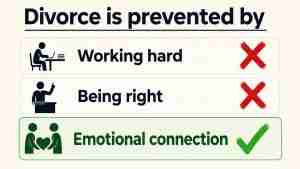
If your desire to get your spouse or kids to do what you think is best prevents doing the behavior which keeps you emotionally connected, your priorities are backwards. It will be a regret that you won’t be able to undo later.
Add an additional step to make working together easier
For more success, give up the direct one-step approach of trying to convince your spouse. When I help people to reconcile, I never have them use a convincing approach as it creates more emotional distance in an already on-the-edge marriage. The convincing approach is one of the biggest reasons people fail to reconcile on their own.
I have written elsewhere about a 7-step approach that I use to help clients to reconcile; it begins with empathy and agreement, with no opposition at all, yet ends with their spouse wanting to reconcile. What is not possible in a single step is possible in a multiple-step approach.

Many problems are less severe than separation or divorce and can be solved with a two-step approach. The first step is emotional connection and not your idea about what needs to be done.
Are you a very logical person?
I work with many logical people who are in the field of engineering and computers. Their logic often causes marriage problems because they miss the emotional component that also needs to be taken care of.

If you are a very logical person, working on connection before working on practical solutions to problems may not make sense to you. But, isn’t it more logical to do what works, even if you are not sure why or think things should be a different way? And, isn’t it a logic failure to keep doing things you think should work if you are not having success?
If you continue to do things that don’t work or work only at the cost of your marriage, I would suggest that you are not as logical as you think you are. The most important truths are not logical, but are true nonetheless.
Connection first, not logic first
What your spouse is saying about the current problem may indeed be terrible, stupid, harmful, immoral, etc., but forcefully pointing that out won’t help. That would just cause fighting, distancing, and disconnection.
For example, consider this dialogue:
Spouse 1: “I think we should withdraw some of our retirement money and take a trip around the world.”
Spouse 2: “What! Are you nuts! Then what are we supposed to do when we retire, eat our souvenirs and live off of our memories?!”
Spouse 2 may be entirely correct, even a bit witty. But being correct and witty is invalidating, condescending, and critical.
If you are sarcastic, stop being that way. The small laugh you get from sarcasm will not erase the hurt you do by being that way. Sarcasm reflects a judgmental personality when we need to have a validating one for successful relationships.
“How can I make a connection when my spouse is saying such things?”
While taking a trip around the world with retirement savings is impractical and could cause financial harm, the idea is not entirely bad. In fact, very few ideas are entirely bad. The desire for a world trip reflects a desire to get out of a routine and spend more time with you, doing something fun. Learning to validate your spouse for the good aspects of what he or she does or says will build your marriage, even when you don’t like what he or she does or says.
Except for verbal abuse, when you would walk away, learning how to validate well is one of the best skills you can have to improve your marriage and solve all kinds of practical problems. Emotional validation makes solving practical problems easier.
By agreeing with those aspects of your spouse’s ideas that are true or good, you make an emotional connection. In turn, this will help him or her to also consider the truth or good aspects of what you are saying.
Your first response should not be practical, but rather it should be validating or clarifying.
Sometimes it is hard to validate immediately because we need a little more information. If you are thinking, “Why would he (or she) say that?” nicely ask for clarification. Then be prepared to validate the clarification.
For example:
Spouse 1: “I think we should withdraw some of our retirement money and take a trip around the world.”
Spouse 2: “Hmm. A world trip. What made you think of that?”
Spouse 1: “I’m bored. We don’t do anything together anymore.”
Spouse 2: “A world trip sure would liven things up. And, it might be a lot of fun.”
Are you having a negative reaction to this example? If so, you might have a belief that agreeing with your spouse means that you have to do what they want. Nothing could be further from the truth. Validating an idea never requires you to take any action.
The response, “A world trip sure would liven things up,” is true. “It might be a lot of fun” is also true. And it has not committed the spouse to any action. Don’t be so fixated on getting your own way or doing the right thing that you can’t admit the truth in what your spouse is saying. This is the art of agreement I wrote about in my book, Connecting through “Yes!”

“But, isn’t agreeing with a harmful idea harmful?”
Notice that the agreement isn’t actually with the harmful aspects of the idea. Those are ignored.
Counselors have been using this method for decades to connect with their clients before persuading them to take healthier actions. Instead of getting freaked out when the client comes up with a terrible idea, the counselor asks how it would help in order to get clarification. Then they agree with the positive aspects of their clients’ ideas.
As a result, clients feel heard and understood. Then, they are more open to hearing what the counselor has to say about it. If the counselor simply said, “That’s crazy!” the client would walk out the door and never come back. Counselors know that to really help clients make good decisions, they need to maintain a good relationship with them. That is true in your marriage as well.
Validate first, problem solve second, and argue not at all. Arguing is never healthy or helpful. Like many common behaviors, it is a destructive one not used by secure and successful people.
Do what the successful minority do if you want to have success.
How to solve money problems (and others) without arguing
The essence of problem solving is coming to win-win decisions together rather than one person being autocratic about it. Autocratic behavior in a marriage is destructive. Instead of being autocratic, simply let the information guide both of you (even though you may already know what the final decision should be):
Spouse 1: “So, how much money shall we withdraw for our world trip?”
Spouse 2: “Let’s take a look at the information so we can make a good decision about it.”
(The couple sit down and look at all the facts including the cost of a world trip and what they would have to each give up in order to do it.)
After considering together both the exciting aspects of traveling as well as the real costs, …
Spouse 1: “Maybe a world trip isn’t such a good idea.”
Spouse 2: “I think you’re right. But, we can still think up some other ways to have fun.”
Discovering together that something is not a good idea is much better than your telling your spouse that he or she has a bad idea, even if you knew it was a bad idea all along. Although it takes a little more time to make financial decisions this way, it keeps you and your spouse connected through the entire process.
Most of the time, people have bad ideas because they are overlooking the downside of what they are choosing. Discussing both the pros and cons will allow you to validate, while also helping the other person to discover problems with their idea.
Validate without judgment
No matter if your spouse’s idea is to buy a bigger home, have an open marriage, have another child, use recreational drugs, or become a vegan, validating and discussing pros and cons will remove judgmental behavior, promote sharing ideas, strengthen your relationship, and lead to practical win-win solutions. For example, the open marriage idea, instead of leading to conflict, can lead to mutually acceptable ideas for adding adventure to your marriage.
What if you do this process, come to some good agreements that you both feel good about, but your spouse does not follow through? It’s not time to start fighting (it never is). It is just time to use another skill.
“We made a budget, but my spouse won’t follow it.”
Perhaps you made a budget together, but your spouse won’t follow it. That could happen with diets, dating, ways to parent the kids, getting along with in-laws or whatever. Being consistent is a matter of willpower and motivation. You may have more than your spouse. Typically one spouse is better with willpower than the other. That is as natural as one spouse being taller than the other. It is not always true, but often it is.
Always have a Plan B
Preparing for failure is the best way to avoid it.
When I help clients learn how to make plans with their spouse, I always introduce the idea of making a backup plan. Having a backup plan encourages people to stick with the first plan, and also gives them recourse if the first plan is not working. No matter how strongly you or your spouse intend to follow Plan A, always have a Plan B. It can even help to have a Plan C, but at least have a Plan B.
For example, regarding finances,
- Plan A might be making a budget together.
- Plan B might be meeting with a financial advisor.
- Plan C might be creating a debit card only allowance account your spouse can use.
Another example with emotional connection,
- Plan A might be going on a weekly date.
- Plan B might be attending a marriage retreat.
- Plan C might be going to marriage counseling.
- Plan D might be a marital separation.
- Plan E might be divorce.
And an example with a child who has poor school grades,
- Plan A might be reducing your child’s phone usage.
- Plan B might be hiring a tutor.
- Plan C might be summer school.
You only ever need to come up with a Plan A and Plan B. But, if Plan A fails, you need to switch to Plan B with your spouse and create a new Plan B. So, you can have a Plan A, B, and C from the beginning or create a new Plan B when Plan A fails (if it does).
Having those backup plans (at least one) allows both of you to see the consequences of not keeping your agreement. This can be used in a discussion, joint problem solving session, or it can be used in a boundary situation. For example, you could either problem solve with your child how to improve his or her grades, or you could lay out your plan about what is going to happen. The same would go for your spouse.
No convincing or arguing
I really want you to notice that at no point is there a need to convince or argue. If you are convincing or arguing, you are not using effective relationship-building methods.
Any negative reaction from your spouse calls for empathy, not argument.
Spouse 1: “I don’t want to go to see a financial counselor.”
Spouse 2: “I don’t want to either. But I love you enough to do it and it could help to prevent needing to set up individual debit accounts.”
You could say the same thing to your kids. Keep in mind that someone not liking something is not the same thing as doing damage. People pleasers often get confused about that.
If you are motivated by love and the desire to create win-win solutions, your spouse will not leave you for it. If your motivation is just to get your spouse to do what you think is best, you may not be able to keep your spouse.
God tells us that without love, all of other efforts, no matter how good we think they are, are meaningless:
If I speak in the tongues of men or of angels, but do not have love, I am only a resounding gong or a clanging cymbal. If I have the gift of prophecy and can fathom all mysteries and all knowledge, and if I have a faith that can move mountains, but do not have love, I am nothing. If I give all I possess to the poor and give over my body to hardship that I may boast, but do not have love, I gain nothing. (1 Corinthians 13:1-3, NIV).
“We didn’t make a backup plan, and now we are in a mess. What can we do?”
Since you did not have a backup plan, at this point, you can try to restart the problem solving and make new plans—including a backup plan. Be sure not to be critical of your spouse’s failure to follow through on the last plan. If you do, then he or she is unlikely to do any problem solving with you.
If your spouse refuses to do problem solving with you, then the main problem has become one of communication and relationship. Set the practical issues aside while you work to strengthen your relationship. Look at my 7 steps for building relationships and work on as many of the steps as you need to. You might need 2, or 3, or more–maybe all seven. The biggest problem in a bad relationship is the relationship itself, so always start with that.

If you are stuck in your relationship building efforts, or you need help with relationship boundaries, I have two resources to help you. A coaching consultation can help you with knowing what to do next. My Re-Connections Coaching Package will help you with any or all of the skills you are missing in getting your spouse’s attraction, love, and commitment.


FAQ
What is the biggest problem couples have talking about money and other things?
Pushing their own opinions rather than validating positive aspects of the other person’s opinions and ideas.
Which comes first? Fixing practical problems or relationship building?
Relationship building comes first, otherwise more conflict will arise when trying to cooperatively fix practical problems. However, working on practical problems on your own can also build the relationship, especially if you are the cause.
Why is it important to validate obviously stupid or immoral ideas?
Because validating what you can will help the other person to be more open to your pros and cons for their idea. Validating a person’s desire to divorce for example, can start the relationship rebuilding process whereas arguing would just push your spouse more toward divorce.
For further study:
Papp, L. M., Cummings, E. M., & Goeke-Morey, M. C. (2009). For Richer, for Poorer: Money as a Topic of Marital Conflict in the Home. Family relations, 58(1), 91–103. https://doi.org/10.1111/j.1741-3729.2008.00537.x